Analytics, Economics, EU – Baltic States, Financial Services
International Internet Magazine. Baltic States news & analytics
Wednesday, 29.07.2026, 19:02
Euro adoption issue becomes increasingly acute regarding Central and Eastern Europe
 Print version
 |
|---|
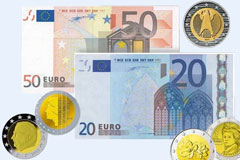
Of the ten countries which joined the European Union in 2004, only two have already entered the eurozone, reports BBC/LETA.
Some experts claim that new EU countries are not strong and flexible enough to join the eurozone.
The global downturn has strengthened this argument as foreign investors have pulled their money out of Eastern European and other emerging markets, hitting their economies hard and sending their currencies into a destabilising tail-spin.
Poland's new pro-integration government wants the country to adopt the euro in 2012. But conservative President Lech Kaczynski is a reluctant backer.
"I speak about [adopting the euro] without enthusiasm because for me the zloty is a very important element of national independence," he told Gazeta Wyborcza, a newspaper.
Having a national currency would enable Poland to determine its own monetary policy, President Kaczynski pointed out.
The eventual adoption of the euro is an obligation, quite possibly a rather beneficial one, the new EU countries have undertaken.
"Single currency membership is not a free lunch," says Neil Shearing, Emerging Europe economist at Capital Economics. "Most notably, it requires transferring monetary policy to Frankfurt."
The economies, that want to adopt the euro, must first become strong and flexible enough to withstand a new financial or economic crisis without being able to implement specific monetary measures, as these powers would be exercised exclusively by the European Central Bank (ECB).
Those sceptical about speeding up the integration of the European Union's newest members into the eurozone point out that they are still far from meeting these criteria.
"Euro adoption requires member states to operate under a one-size-fits-all interest and exchange rate and that, in turn, requires that their economies have converged, both structurally and cyclically," says Mr Shearing.
Countries in the eurozone are expected to comply with the Stability and Growth Pact, seen as a tool to impose budget discipline, including curbing inflation and keeping budget deficits below 3%.
Mr Shearing pointed out that Emerging Europe remains relatively poor in comparison with the existing eurozone members, and as such tends to suffer from higher rates of inflation.
Moreover, "labour market reforms remain incomplete across large swatches of the region", he points out, including in the Baltics, "the most flexible economies in the region".
Consequently, although the eventual adoption of the euro could bring about growth in trade and foreign direct investment, meeting the criteria might be a painful process.
"The resulting impact on the real economy has been well documented," according to Mr Shearing. "Output could fall by 20% over the next couple of years."
Some aspects of the accession rules were in the interest of candidate countries, but others "are made for a different time and era", Ms Shadler explains. "The inflation criteria and the exchange rate stability criteria are just not possible for these countries in this situation to meet simultaneously," she says. "Unless they get lucky."
From her point of view, there should be a rethinking of what it takes to get in the euro area, as it would benefit both the existing euro area members and the new members.
"Just to let the countries in without any fiscal plan would be straining the credibility of the euro area's process," says Ms Schadler. "[But] I believe that euro adoption remains an absolutely key opportunity for the Central European economies to help reduce risks in their economies and secure stability. The crisis they are experiencing right now only underscores how important the goal was, is and will be for future years."
However, Shearing warns: "The bottom line is that, while early adoption of the euro would carry some benefits, we think it would ultimately risk storing up even greater problems for the future."
The euro has successfully established itself as a global currency.
It now looks like it could be asked to take on larger role of a saviour of troubled economies.






 «The Baltic Course» Is Sold and Stays in Business!