Direct Speech, Education and Science, EU – Baltic States, Interview, Latvia
International Internet Magazine. Baltic States news & analytics
Thursday, 18.06.2026, 09:49
Address of Mats Staffansson in the Museum of Modern Art in Riga
 Print version
 |
|---|
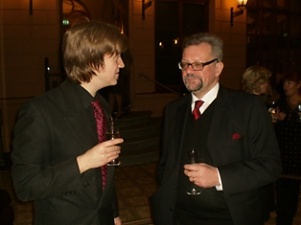
| The pianist Ugis Krisjanis and Mats Staffansson In the Art Museum. Riga, 8.11.2011. |
Warmly welcome to this celebration of the founder of the Nobel Prize, Alfred Nobel, here in this beautifully renovated building of the old Riga stock exchange.
The tenth of December, is celebrated in Sweden as the Nobel Day. The Nobel Prize is probably the most prestigious international award in the world and the 10 December is one of the most important days of the Swedish calendar.
On this day, all the Nobel Prize winners receive their awards from the hands of His Majesty the King of Sweden in Stockholm. The exception is the Nobel Peace Prize, which is presented in Oslo.
This year is a special year. On the tenth of December it will be exactly 115 years since the founder of the Nobel Prize, the famous Swedish industrialist Alfred Nobel, passed away, leaving as his last will his enormous fortune to science. It will also be exactly 110 years since the first Nobel prizes were handed out, on 10 December 1901.
During the next 15 minutes, I will tell you briefly about the origin of the prize and of Alfred Nobel himself. It is actually quite a fascinating story and I don’t think you will find it boring.
So let’s travel back in time some 180 years. And let’s move geographically some 400 kilometres to the northwest from Riga, across the Baltic Sea, to the city of Stockholm.
In that city, within a period of four years, three brothers were born into a family, where science was held in high regard. The three brothers would all be very famous, and also enormously rich. Their family name – Nobel – would be known all over the world.
The oldest of the three brothers was Robert Nobel. The middle one was Ludvig Nobel. And the hero of our story, Alfred Nobel, the youngest of the three brothers, was born in 1833.
Their father, Immanuel Nobel, was a successful engineer and inventor with a business of his own. Unfortunately, the same year that Alfred Nobel was born, the family business suffered huge losses and had to be closed.
Luckily, the mother of the three boys came from a wealthy family. She started a small grocery store which supported the family during a few difficult years, when the father looked for new business opportunities.
After four years he moved on across the Baltic Sea, to Finland. The family stayed in Stockholm. He opened a business in Helsinki but moved on quite soon to the largest, richest and most dynamic city in Northern Europe in those days – to the capital of Russia, St Petersburg.
Immanuel Nobel opened a mechanical workshop in Petersburg which provided equipment for the Russian army. His business in St. Petersburg developed fast and he started to get big orders. He invented and constructed sea mine and convinced the Russian Tsar and his generals that they could be very effective in preventing enemy ships from entering and tacking St. Petersburg. The mines his factory produced actually stopped the British Royal Navy from moving into firing range of St. Petersburg during the Crimean War in 1853-1856.
With his success, Immanuel was now able, after five years away from Stockholm, to move his family to Russia. This was 1842, and Alfred was nine years old when he moved to St. Petersburg.
After a year in Petersburg, in 1843, a fourth son, Emil Nobel, was born into the family.
The four Nobel brothers were given first class education in St. Petersburg with the help of private tutors. The lessons included natural sciences, languages and literature. At the age of 17, Alfred could already speak and write fluent Swedish, Russian, French, English and German. Later in life he also learned fluent Italian
Alfred seemed to have been the one of the four boys to show most talent for science, so the father decided to send him abroad to study in order to become a chemical engineer. When Alfred was 18, he went to the United States and stayed their for four whole years, studying chemistry. Returning after four years to Europe, he continued his studies in Paris, where he worked in the private laboratory of a famous French chemist and professor.
In that laboratory, he met an Italian chemist, Ascanio Sobrero. That meeting would seal Alfred’s fate. Three years earlier, Sobrero had invented something he called nitro-glycerine. It was a highly explosive liquid. No-one was actually very interested in it. It was considered much too dangerous to be of any practical use whatsoever. Sobrero himself was actually so frightened by his own discovery that he had kept it secret for more than a year.
But Alfred became fascinated by nitro-glycerine and saw immediately possibilities of using it in construction work. When he returned back to Russia he started working together with his father to develop nitro-glycerine as a commercially and technically useful explosive.
When the Crimean War ended, the business of Alfred's father took a turn for the worse. Orders stopped coming in and he decided to move back with his business to Sweden, having spent 20 quite prosperous years in Russia.
Alfred and the youngest of the sons, Emil, followed their father back to Stockholm.
Alfred's two older brothers Robert and Ludvig decided to stay in Russia. They were both more than thirty years old, and had lived for twenty of those years in Petersburg. They preferred to stay in order to save what was left of the family business in Russia.
As it happened, this turned out to be a very wise decision.
After a few more years with the family business in Petersburg they went south and started to take an active interest in the emerging oil industry in what is today Azerbaijan.
They opened a company in Baku called Branobel, which stands for “The ´Nafta Industry of the Nobel Brothers”. The shareholders were the three oldest brothers Nobel - Robert, Ludvig and Alfred.
Up until then, the United States had been the undisputed world leader in all aspects of the oil business. The roles were reversed by the two Nobel brothers.
The oil business up until they took an interest in it was quite rudimentary and lacked technical know-how and scientific methodology. The Nobel brothers established advanced technical chemical research laboratories in Baku, where dozens of scientists were employed, finding ways to treat oil, developing new uses for oil, and developing products derived from oil.
Robert and Ludvig Nobel were the first in the world to experiment with carrying oil in bulk on single-hulled barges. The first successful oil tanker in the world, the Zoroaster, was built by the brothers. Their company, Branobel, even managed to build a pipeline from the oil fields in Baku through Georgia to Batumi on the Black See – an incredible achievement in those days!
The business developed at an incredible speed and Robert and Ludvig became enormously successful and wealthy businessmen. Alfred was not involved in the operations but continued to be a shareholder and part of his later great fortune steams from the company run by his two brohers.
Branobel grew to become the largest company in Russia - a sort of Gazprom or Rossneft of those days – and the second largest oil company in the world after Rockefellers Standard Oil. At one point, Branobel produced almost 50% of the world's oil and had more than 50.000 persons employed around the world.
Today, these two Swedish brothers - Robert and Ludvig Nobel – the older brothers of Alfred Nobel - are credited with being the founding fathers of the Russian oil industry.
But let’s now move back to our main person, to Alfred Nobel.
As I mentioned, Alfred left Russia with his father and youngest brother Emil and returned to Stockholm in 1863. Back in his native country Sweden, Alfred concentrated on developing nitro-glycerine as an explosive, together with his father and his youngest brother Emil
These experiments were extremely dangerous. Many serious accidents happened.
Tragically, during one of these explosions Emil, Alfred's younger brother, died, causing Alfred enormous sorrow and grief. Emil was only 20 years old and had lived almost his entire life in St Petersburg.
After this fatal explosion, the Swedish government decided to ban these highly dangerous experiments within the Stockholm city limits.
But Alfred did not give up. He moved his experiments to other places outside Stockholm.
In 1864, he was able to start mass production of nitro-glycerine and continued to experiment with different additives to make the production much safer.
During one of these experiments, he found, that if you mix nitro-glycerine with a special and fine kind of sand, you could actually turn the liquid into a sort of paste. That paste could be shaped into rods and the rods could then be inserted into drilling holes. This crucial invention was made by Alfred in 1866. He got a patent and legal right of ownership of this material which he called "dynamite" – a words with Greek roots meaning “connected to power”.
Alfred also invented a detonator or blasting cap which could be set off by lighting a fuse.
This was the best possible timing! These inventions came at a time, when the diamond drilling crown and pneumatic drill came into general use. Together, these inventions drastically reduced the cost of many construction works like drilling tunnels, blasting rocks, building bridges, etc. Dynamite and detonating caps quickly became products in high demand in the construction industry. In a short time, Alfred was able to put up factories in 90 different places in 20 different countries!
He also experimented in making synthetic rubber and leather and artificial silk and by the time of his death in 1896 he had 355 unique patents.
During the last years of his life, Alfred Nobel resided permanently in Paris but travelled all the time around Europe and the world to his factories. He was sometimes described as "Europe's richest vagabond."
A question often asked is why Alfred Nobel actually decided to found the Nobel Prize and to dedicate his enormous fortune to science?
We may never know the true answer.
One reason may be, of course, that in spite of a few documented love stories, Alfred Nobel never married and did not have any children of his own. Further more, his parents and all of his three brothers died before him. Emil died young, as I mentioned, and the two older brothers were enormously rich themselves and left large fortunes to their children.
But there is also a fascinating legend. It may be only a legend but it does perhaps cast some light on why Alfred Nobel decided to write this testament and give his estate to science.
The story goes like this:
In 1888 Alfred's older brother Ludvig was visiting Alfred in France when he suddenly died of a heart attack.
A French newspaper thought it was Alfred Nobel who had died and the paper erroneously published an obituary of Alfred Nobel instead of Ludvig.
It was not a flattering obituary.
It condemned Alfred for his invention of dynamite and was titled
“Le marchand de la mort est mort » ("The merchant of death is dead”)
The obituary went on to say, "Dr. Alfred Nobel, who became rich by finding ways to kill more people faster than ever before, died yesterday” in Cannes”. .
Alfred was very sad, disappointed and offended with what he read and concerned with how he would be remembered after his own death.
According to the legend, this incident was one of the reasons behind his decision to leave a better legacy after his death. Whatever the real truth in this story is, seven years later, on 27 November 1895, at the Swedish-Norwegian Club in Paris, Alfred Nobel signed his last will and testament. A year later he died of a stroke in San Remo, Italy on December 10, 1896.
In his testament, Alfred Nobel gave the bulk of his estate to establish the Nobel Prizes to annually award those who have done their best for humanity in the field of physics, chemistry, physiology or medicine, literature and peace, without distinction of nationality.
After taxes and bequests to individuals, Nobel's will gave more than 31 million Swedish Kronor to fund the prizes. This was an enormous sum in those days. In today’s value, it would be the equivalent to about 300 million US dollars.
Not everybody was pleased with this testament. His will was opposed by some relatives – mainly by the children of his oldest brother, Robert and it was questioned by authorities in various countries. It took four years for his executors to convince all parties to follow Alfred's last wishes.
And on 10 December 1901, on the fifth anniversary of Alfred Nobel’s demise, the Nobel Prizes in Physics, Chemistry, Physiology or Medicine and Literature were awarded for the first time in Stockholm, Sweden and the Peace Prize in Kristiania (now Oslo), Norway.
In 1968, the central bank of Sweden, Sveriges Riksbank, established The Sveriges Riksbank Prize in Economic Sciences in Memory of Alfred Nobel.
That prize is nowadays also counted as a Nobel prize and is being awarded the same day as the other prizes.
Each prize consists of a medal, a personal diploma, and a large cash award, amounting to around 1 million euros.
--------------------------------------------
So the day after tomorrow, on Saturday, 10 December, on the Nobel Day, His Majesty the King of Sweden will hand out the Nobel Prizes for this year in Stockholm.
This beautiful ceremony is followed by a big Nobel banquet in the city hall of Stockholm the same evening which is transmitted live on television in many countries in the world. This is an extremely prestigious event, and to be invited to participate in the Nobel dinner is among the highest honour one can receive.
 |
|---|
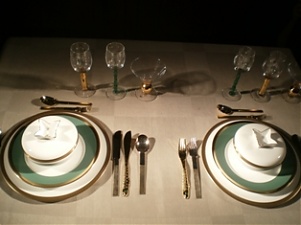
During the dinner, the exquisite dishes, which are always created by the top chefs of Sweden, are served on exclusive plates – the famous Nobel Service.
This dinner service is made in the old porcelain factory of Rörstrand and was specially created for the 90:th anniversary of the Nobel prize in 1991.
The Nobel Service has been awarded with several international design awards. The colours of the different plates are supposed to symbolize “the seasons of the year, the continents and the best of the Nobel prizes”.
And it is one such full Nobel Service which I have the honour of presenting today as a gift to the Museum of Foreign Art from the Embassy of Sweden in Latvia.
Thank you very much for your attention.







 «The Baltic Course» Is Sold and Stays in Business!