Analytics, Latvia, Tourism
International Internet Magazine. Baltic States news & analytics
Saturday, 28.02.2026, 16:40
Spires, Towers and Steeples – A View of Old Town Riga
 Print version
Valdemara from the southeast where the cityscape unveiled its true character. From this point, my first impressions drew clearer like the near instant evolution of a 1970s Polariod photograph. Here is where church spires, clock towers, steeples, cupolas and turrets puncture the serene skyline as symbols of local pride and prestige; extending the zone of visual influence from which the city’s magnificent churchesmay be seen.
While the panoramic view of Old Town was certainly memorable, I might be more inclined to suggest that it is the strategic short-range views that contribute substantially to the character and setting of Old Town. I therefore elected to leave the Old Town Walk brochure at the hotel, trusting a more organic approach to exploration based entirely on the strength and magnetism of spectacular vistas and well-framed view corridors punctuated by expressive landmarks in conjunction with the reverberating sound of well-worn heels over narrow stone-cobbled streets.
 |
|---|
| St Peter’s Church. |
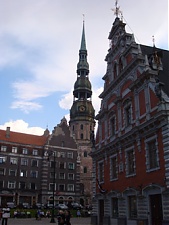
This picture is taken from the City Council Square (Ratslaukums) looking east in near axial alignment with the striking segmental spire of St Peter’s Church (1209) in the centre background; framed at the base by the projecting shaped-gable fronting on to Kungu iela in the left mid ground and in vertical tandem with the elaboratelysculptured Gothic-style House of Blackheads in the right foreground. Here, a superb short-range view of St Peter’s Church reveals one of the best examples of Gothic architecture in the Baltics in exceptional synergy with the House of Blackheads, which was originally built in 1344; destroyed in 1941; and rebuilt in 2001 to commemorate the city’s 800th anniversary.
I understand that the sectional tower of St Peter’s Church has been rebuilt several times including after its collapse in 1666 and after it suffered extensive damage during the war in 1941. While its iconic design is of considerable visual interest, it is also a remarkable reminder of the concerns raised in earthquake-prone areas regarding the lateral stability of tall chimneys, towers and parapets in un-reinforced masonry buildings.
 |
|---|
| Riga Dome Cathedral. |
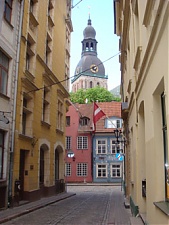
This view captures the sense of enclosure resulting from canyon-like vistas framed by the Museum of the Barricades and the three-storey classically-inspired building in the left and right foregrounds respectively, as experienced from Kramu iela.
Here, the elegant proportions of the Dome Cathredral rises decisively in the background, beyond the colourful low-rise domestic architecture capped with steeply-pitched roofs fronting on to Jauniela iela, closing-out the magnificent terminal view against the
clear blue Riga sky.
The Dome Cathedral, built in 1211, is one of the largest and oldest buildings in the Baltics, despite being destroyed and rebuilt many times, the latter taking place most recently in 1776.
 |
|---|
| Convent’s Yard. |
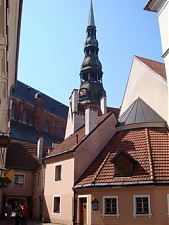
From the next view, St Peter’s Church, with its 137m high viewing platform dominates the skyline with absolute confidence as experienced from deep within the domestic-scale cluster of built form within Convent’s Yard (Konventa Seta), one of the oldest building complexes in Old Town. '
From this viewpoint, the porcelain painting workshop in the left foreground presents a heavily-modulated façade in contrast to the “Apsida” Art Museum to the right where the immediate view is characterized by traditional Latvian architectural features of special interest including deeply-punched openings in smooth-rendered walls, multiple slender chimney stacks, gable dormers and steeplypitched slate roofs all demonstrating a distinct and practical response to the local climate.
Leaving the Convent’s Yard via Skunu Skarnu iela, one might backtrack northwards passing along the east side of Doma laukums to Pils iela where the magnetism of yet another landmark awaits around the corner as seen from M. Miesnieku.
 |
|---|
| St Jacob’s Church. |
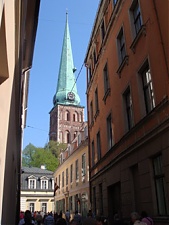
The next picture captures the epitome of the city’s special views where the narrow pedestrianised street incorporates a spectacular mid-range view. Here, the four-storey classicallyinspired Baltikums private bank in the left foreground in conjunction with the office block just opposite exposes the terminal landmark view to St Jacob’s Church (1225) rising over pedimented dormers of the mansard roofs and lush greenery beyond.
The Church’s hexagonally-tapered spire is topped by a guilded cock, which is most symbolic of traditional Latvian folklore, safeguarding the city from evil.
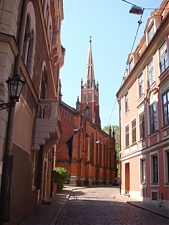
The foregoing landmark spires do have visual similarities worth nothing: they appear of relatively lightweight construction and are likely to be subject to enormous wind stresses; they all rise behind mid ground buildings; and they all have some form of voluptuousness about them; whereas a short stroll westward to Anglikanu street will cause even the most hurried pedestrian to halt in their tracks as the modulated hexagonal needle-spire of St Savior’s Anglican Church (1857) is framed by fourstorey structures including the Danish Embassy in the left foreground characterising a tight urban grain chiseled out by narrow winding cobbled streets.
 |
|---|
| St Savior’s Anglican Church. |
In view 5, one can distinguish the dominating tower from those in previous views by the sheer strength of its linearity and surface modulation, particularly since it is embraced by a parapeted squared tower thrusting outward with corner buttresses terminated by conical finials all producing an elegantly proportioned and richly-decorated landmark building.
By the time I had discovered just these “special views”, I was convinced that there was a distinct theme that was so pronounced; so clear; and so rewarding that it warranted further reflection. I set out to explore this Baltic city with an interest in the historic environment. Of course I only scratched the tip of the iceberg; however, I am certain that further explorations will be forthcoming.
Take a walk through Old Town, and seek out the special views from within the historic urban core. While it is city whose post-card panoramic views can be fully appreciated from the south side of the Daugava River; and a bird’s eye view can be experienced from the 26th floor of the Skyline Bar; St Peter’s Church; as well as the Television Tower; its impressive short-range vistas make a significant contribution to the character and setting of Old Town and are best experienced on foot. This city founded in 1201, reflects an eclectic architecture steeped in medieval origins with remnants of the Stalinist period. Architecturally speaking, while world-renown for its Art Nouveau District, it is certainly a city of spires, towers and steeples, whose special views ought to be enjoyed by present and future generations.
About G. Miller MurrayMurray G. Miller is a Canadian conservation architect and heritage planner; Senior Executive, Architecture & Heritage with Stephen Levrant Heritage Architecture Ltd.; architects and historic building consultants specializing exclusively in the historic environment throughout the United Kingdom and abroad. [email protected] |









 «The Baltic Course» Is Sold and Stays in Business!