Agriculture, Analytics, Good for Business, Latvia, Markets and Companies
International Internet Magazine. Baltic States news & analytics
Sunday, 13.09.2026, 16:23
At the end of 2010 the number of livestock in Latvia has increased
 Print version
The growth of the number of cattle was influenced by the increase of the number of young stock and cows, especially of suckling cows – by 3.2 thousand or by 20.8%, nevertheless, the number of dairy cows has reduced by 1.4 thousand or by 0.9%.
Number of livestock at the end of the year (1) (in thousands)
|
|
2009 |
20102 |
2010as % of 2009 | |
|
Cattle |
378.2 |
379.5 |
100.3 | |
|
of which |
|
|
| |
|
|
dairy cows |
165.5 |
164.1 |
99.1 |
|
Pigs |
376.5 |
389.7 |
103.5 | |
|
Sheep |
70.7 |
76.8 |
108.7 | |
|
Goats |
13.2 |
13.5 |
101.8 | |
|
Horses |
12.6 |
12.0 |
95.4 | |
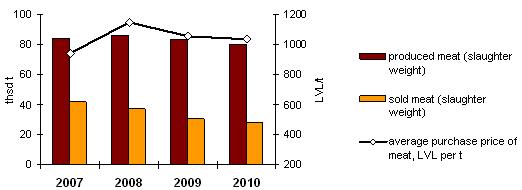
2010 79.9 thousand tons of meat were produced, and it is 4% less than in 2009. This reduction was influenced by the drop of the beef and pork production – by 10.0% and 4.3%, respectively. Share of beef and pork in the total volume of meat comprises 70%. But production of poultry and sheep meat, in turn, grew – by 1.4% and 0.5%, respectively.
Reduction of the volume of produced meat was influenced by the increase of export of live pigs. In comparison with 2009, the number of exported pigs in 2010 rose by 59%. The average purchase price for meat (in slaughter weight) decreased from LVL 1054.98 per ton in 2009 to LVL 1032.85 per ton in 2010 or by 2.1%. Prices of pork reduced noticeably – by 6.6%, but prices of beef and seep meat grew – by 2.1% and 23%, respectively.
 |
|
Meat production, sale to meet procurement and processing enterprises and average purchase price |
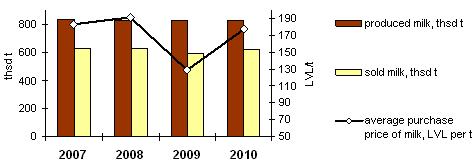
Last year the average milk yield from cow reached 4998 kg, a growth of 106 kg or 2.2%, if compared to the year before. Compared to the year before, volume of goat milk produced comprises 157 tons or 5% more than in 2010.
In 2010 the volume of milk sold to milk procurement and processing enterprises has increased. 625.2 thousand tons of milk were purchased, and that is 5% more than a year before. Share of sold milk in the total volume of produced milk has reached 75.2% (in 2009 – 72%), and that mainly was influenced by the growth of milk purchase prices.
Average purchase price of milk grew from LVL 129.23 per ton in 2009 to LVL 177.82 in 2010 or by 37.6%, reaching the highest purchase price in December – LVL 196.23 per ton. Growth of milk purchase prices mainly were influenced by the situation in world market – prices of grain and fuel rose, and that, in turn, increased the production costs of milk.
 |
|
Milk production, sales to milk procurement and processing enterprises and average purchase price |
In 2010 714.9 million eggs were produced, 4.9% up on the previous year. One laying hen on average produced 274 eggs or 0.7% more than a year before. The average sale price for eggs has decreased from LVL 4.75 per 100 eggs in 2009 to LVL 4.28 in 2010 or by 9.9%.
Output of livestock products
|
|
2009 |
20102 |
2010as % of 2009 | |
|
Meat (slaughter weight), thsd t |
83.2 |
79.9 |
96.0 | |
|
of which: |
|
|
| |
|
|
cattle |
20.5 |
18.4 |
90.0 |
|
|
pig |
38.8 |
37.2 |
95.7 |
|
|
poultry |
22.8 |
23.5 |
101.4 |
|
Milk (incl. goat milk) thsd t |
831.5 |
834.5 |
100.4 | |
|
Eggs, mln pieces |
681.4 |
714.9 |
104.9 | |
1 Data source for the number of cattle, sheep, goats and horses is information of State Agency Agricultural Data Centre.
2 provisional data









 «The Baltic Course» Is Sold and Stays in Business!