Analytics, Baltic States – CIS, Democracy , Estonia, EU – Baltic States, Legislation
International Internet Magazine. Baltic States news & analytics
Sunday, 05.04.2026, 12:23
Estonia stays high in democracy index 2014
 Print version
The Freedom House report on the development of democracy in post-communist countries highlights the recent setbacks in the governance of Eurasian, Balkan and Central European countries. Among the 29 states rated in 2013, only 13 countries had democratic governance, including in Estonia; six countries are still in a transitional phase, and 10 countries have authoritarian regimes.
In 2013, the average democracy index fell among transition countries, but for Estonia, there was no change in the index over the previous year.
Despite the fact that in 2013, the Estonian media landscape was rocked by a number of events, there was no change in the rating of media freedom. "This is the highest rated sphere among the sub-themes that were focused on," notes Hille Hinsberg, expert of think-tank Praxis that was chosen by Freedom House to evaluate democracy in Estonia.
Hinsberg pointed out that over the years, management of elections and civil society have steadily gained a high rating. Also highly valued is Estonia's independence of the legal environment.
The chart below shows the difference between Democracy Scores in NIT editions 2005 and 2014.
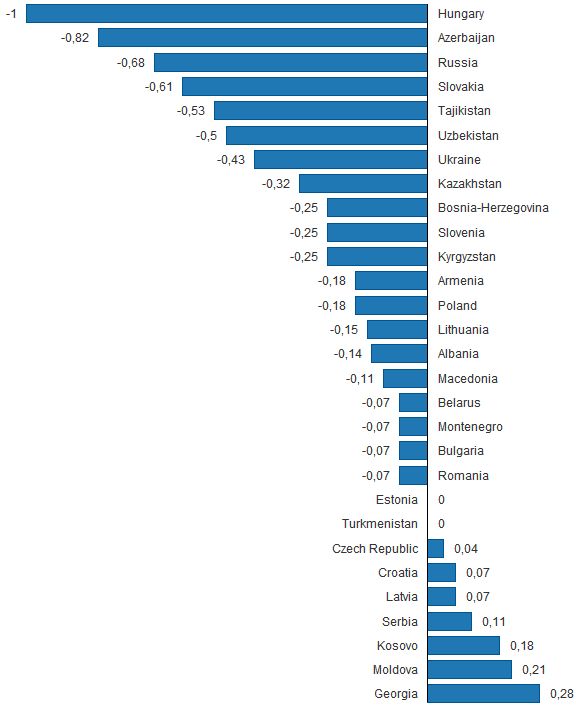 |
| Biggest Gains and Declines |
State governance, democratic local governments and corruption were rated lower than other spheres.
The 18th edition of Freedom House’s
comprehensive report on post-communist democratic governance highlights recent
setbacks to democracy across Eurasia and the Balkans, as well as in Central
Europe.
Russia served as the model and inspiration for
policies that have led to an uninterrupted retreat from free institutions
throughout Eurasia and in 2013 brought a new and alarming level of repression.
In Ukraine, Kyrgyzstan, and several other
countries, civil society responded with remarkable resistance to repressive
governance. The year also featured improved elections and peaceful transfers of
power in Kosovo, Albania, and Georgia.





 «The Baltic Course» Is Sold and Stays in Business!