Baltic, Competition, Education and Science, Round Table
International Internet Magazine. Baltic States news & analytics
Tuesday, 09.06.2026, 08:30
Innovation is a key factor to determine productivity growth
 Print version
 |
|---|
The EIS attempts to benchmark, on a yearly basis, the innovation performance of Member States, drawing on statistics from a variety of sources, primarily the Community Innovation Survey. The Innobarometer complements the results of the EIS by analyzing specific aspects of innovation through a survey of 3,500 randomly selected companies in the EU.
In 2006, the theme of the Innobarometer was the role of clusters in facilitating innovative activity. In 2007, the Innobarometer will explore the subject of non-research based innovative companies.
The 2007 European Innovation Scoreboard was published on 14 February 2008. It provides a comparative assessment of innovation performance across EU Member States and with major innovating countries worldwide, together with new analysis on innovation in services, on socio-economic factors influencing innovation, on innovation efficiency and on non-R&D innovation.
Overall innovation performance is calculated on the basis of 25 indicators covering five dimensions of innovation (see Table 1):
1. Innovation drivers measure the structural conditions required for innovation potential;
2. Knowledge creation measures the investments in R&D activities;
3. Innovation & entrepreneurship measures the efforts towards innovation at the firm level;
4. Applications measures the performance expressed in terms of labour and business activities and their value added in innovative sectors; and
5. Intellectual property measures the achieved results in terms of successful know-how.
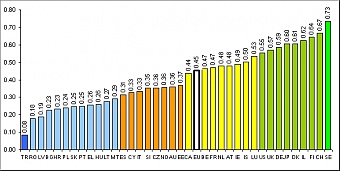
Based on performance over a five year period, four main groupings of countries emerge (see Figure 1):
1. Sweden, Switzerland, Finland, Israel, Denmark, Japan, Germany, the UK and the US are the innovation leaders (9 countries), with scores well above that of the EU27 and most other countries. Sweden is the most innovative country, with the highest score of all countries
2. Luxembourg, Iceland, the Netherlands, Ireland, Austria, France, Belgium and Canada are the innovation followers (8 countries), with scores below those of the innovation leaders but equal to or above that of the EU27.
3. Australia, Estonia (see Figure 4), Slovenia, Norway, Czech Republic, Italy, Cyprus and Spain are the moderate innovators (8 countries) with scores below that of the EU27.
4. Malta, Lithuania (see Figure 3), Hungary, Greece, Slovakia, Poland, Croatia, Bulgaria, Portugal, Latvia (see Figure 2) and Romania are the catching-up countries (12 countries). Although their scores are significantly below the EU average, these scores are increasing towards the EU average over time with the exception of Croatia. Turkey is performing below the other countries.
Latvia
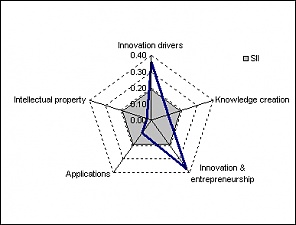
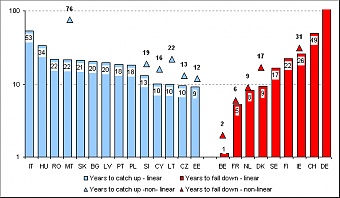
Latvia's overall innovation performance places it among the group of "catching-up countries" with a performance that is well below EU average but increasing towards the EU average over time. Based on current trends, Latvia would reach the EU average level of innovation in performance in around 20 years (see Figure 5). Latvia ranks relatively highly on the dimension of Innovation drivers where it is above the EU average on the indicator of Youth education attainment level. It performs relatively weakly on the dimension of Applications, where it is well below the EU average on the indicators of Exports of high technology products, Sales of new-to-firm products and Medium-high/ high-tech manufacturing employment. The analysis shows that Latvia is below average in its efficiency of transforming innovation inputs into outputs.
Lithuania
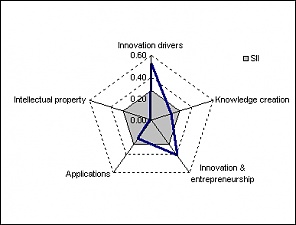
Lithuania has an overall innovation performance that places it among the group of “catching-up countries” with a performance that is well below EU average but increasing towards the EU average over time. Over the past 5 years Lithuania’s innovation performance has increased rapidly and based on this trend it would reach the EU average level of performance within ten years (see Figure 5). Lithuania performs particularly strongly on the dimension of Innovation drivers, where it is above EU average on the indicators of S&E graduates, Population with tertiary education and Youth education attainment level. It performs at a relatively lower level on the dimension of Intellectual property. The analysis indicates that Lithuania is less efficient than EU average in transforming innovation inputs into outputs.
Estonia
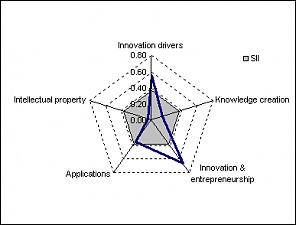
Estonia’s innovation performance ranks it among the “moderate innovators” with a performance that is below EU average but above the group of “catching up” countries. Estonia’s innovation performance has been increasing over the past 5 years compared to the EU average. It is on track to reach the EU average level of innovation performance within 10 years if current trends continue (see Figure 5). Estonia is ranked fourth in the EU in the Innovation & Entrepreneurship dimension, where it well above average on the indicators of SMEs innovating in-house, ICT expenditures and SMEs using organizational innovation. It also has a relative strength in the Innovation drivers dimension, where it is already above the EU average on indicators of population with tertiary education, broadband penetration rate and youth education attainment level. However, Estonia is relatively weaker in the Knowledge creation dimension, where it scores well below average on indicators of business R&D expenditures, enterprises receiving public funding. It is also relatively weaker in the Intellectual property dimension. Estonia is below EU average in its efficiency of transforming innovation inputs into outputs (both Applications and Intellectual Property).
|
1. Innovation Drivers | |
|
1.1 |
S&E graduates per 1000 population aged 20-29 |
|
1.2 |
Population with tertiary education per 100 population aged 25-64 |
|
1.3 |
Broadband penetration rate (number of broadband lines per 100 population) |
|
1.4 |
Participation in life-long learning per 100 population aged 25-64 |
|
1.5 |
Youth education attainment level (% of population aged 20-24 having completed at least upper secondary education) |
|
2. Knowledge Creation | |
|
2.1 |
Public R&D expenditures (% of GDP) |
|
2.2 |
Business R&D expenditures (% of GDP) |
|
2.3 |
Share of medium-high-tech and high-tech R&D (% of manufacturing R&D expenditures) |
|
2.4 |
Share of enterprises receiving public funding for innovation |
|
3. Innovation & Entrepreneurship | |
|
3.1 |
SMEs (small & medium size enterprises) innovating in-house (% of all SMEs) |
|
3.2 |
Innovative SMEs co-operating with others (% of all SMEs) |
|
3.3 |
Innovation expenditures (% of total turnover) |
|
3.4 |
Early-stage venture capital (% of GDP) |
|
3.5 |
ICT (Information and Communication Technology) expenditures (% of GDP) |
|
3.6 |
SMEs using organizational innovation (% of all SMEs) |
|
4. Applications | |
|
4.1 |
Employment in high-tech services (% of total workforce) |
|
4.2 |
Exports of high technology products as a share of total exports |
|
4.3 |
Sales of new-to-market products (% of total turnover) |
|
4.4 |
Sales of new-to-firm products (% of total turnover) |
|
4.5 |
Employment in medium-high and high-tech manufacturing (% of total workforce) |
|
5. Intellectual Property | |
|
5.1 |
EPO patents per million population |
|
5.2 |
USPTO patents per million population |
|
5.3 |
Triad patents per million population |
|
5.4 |
New community trademarks per million population |
|
5.5 |
New community designs per million population |
|
Source: PRO INNO Europe. | |
 |
|---|
| Figure 1: The 2007 Summary Innovation Index (SII). |
 |
|---|
| Figure 2. Performance chart by innovation dimension in Latvia. |
 |
|---|
| Figure 3. Performance chart by innovation dimension in Lithuania. |
 |
|---|
| Figure 4. Performance chart by innovation dimension in Estonia. |
 |
|---|
| Figure 5. Time to catch up or fall back to EU average performance. |









 «The Baltic Course» Is Sold and Stays in Business!