Analytics, Crisis, Direct Speech, Education and Science, Financial Services, Forum, Latvia, Round Table
International Internet Magazine. Baltic States news & analytics
Tuesday, 09.06.2026, 06:37
State Management at a time of crisis
 Print version
 |
|---|
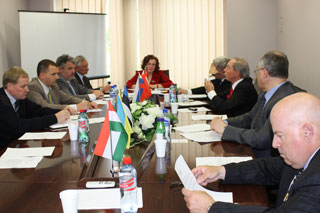
As all the invited RT’s participants acknowledged during discussions, the issues of crisis management and Latvian economic management in particular have been analysed for the first time in the country’s modern history.
The Round Table organizers expressed their hope that experts’ recommendations would supplement Latvian government’s efforts in stability plan’s implementation.
Besides numerous participants in the RT, several politicians, academicians and businesspersons had sent their articles for the Round Table discussions. These were, for example, Hungarian Ambassador in Latvia, Ishtvan Mohachi, financial expert, Michael Bazilinskij (Canada), Alexander Gaponenko (Latvia), etc.
Below followed extracts from some of the papers presented at the Round Table.
Russian versions of the papers presented for the round-table can be found at:
http://www.baltic-course.com/rus/kruglij_stol/?doc=14010
 |
|---|
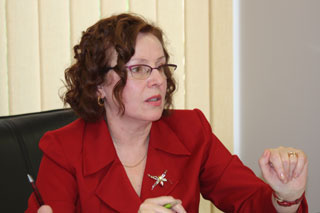
| Olga Pavuk, Dr. econ. Assoc. Prof., Baltic International Academy. |
The RT’s permanent moderator, Dr. Olga Pavuk in the introductory speech and the supplement materials for discussions underlined that Latvian crisis, being deeper than in any of other EU member states, including the Baltic countries, was rooted in the lack of efficient and knowledgeable state economic management during all the years since the newly acquired independence in 1991. During last two decades the nation economy development can be described as spontaneous.
The author specifies several stages in economic management; each of these stages have been leading to the next stages –more or less deeper that the previous ones. Therefore, the crisis is associated at the same time, argued O. Pavuk, with the immoral conduct of civil servants being quite satisfied with high salaries, additional fees and various bonuses.
First of all, Dr. O. Pavuk specified three stages in Latvian banking sector’s development. First, up to mid-1990s was the period of extensive sector’s growth with several dozens of financial institutions and growth of deposits-dividends functional operations. The period ended, as it could be expected with the fall of numerous banks, e.g. Banka Baltija in 1995.
Second, up to the beginning of 2000 was dominated by the Latvian banks’ activity on the Russian financial market where the rate of investments reached 100 percent. And this period ended in crisis, i.e. several banks were ruined and the number of banks stabilized at the level of 24-25 banks.
Third stage, since 2001 up to the present economic and financial crisis was dominated by the growth of private and corporate credits: they were easily accessible and cheap. It involved a crackdown of the biggest Latvian private bank -Parex banka in 2008.
In general, concluded O. Pavuk, the last decade has been extremely profitable for the banking sector, which to about 70 per cent has been dominated by the foreign capital. For example, aggregated profit of the 25 existing banks in Latvia has increased in 2007 by 73 per cent and reached 371,3 mln lats. However in 2008 the banks’ profitability was reduced by 76 per cent; however providing the banks with a sizable liquidity of 89,4 mln lats.
Dr. O. Pavuk specified several focal points in the country’s economic development as well.
Looking at the Latvian economic development from the point of country’s GDP structure, there can be seen certain common features that augmented the national crisis after all.
To begin with, in 1990s, after forceful liquidation of the main big enterprises (as an industrial legacy from the Soviet time) the wood-processing and light industry played main roles in economic development. Both industrial sectors have been oriented towards export, which was not bad for the whole economy at all. Hence, “wooden sector” in the conditions of completely uncontrolled wood-cut-rules during more than 10 years made a great deal in the country’s GDP; up to 90 per cent of wood products were exported and the sector employed about 60 thousand people. Needless to say that the sector was an attractive place for foreign investments driven by low production costs. It is wellworth noticing, said Ms. Pavuk that in the Soviet time industrial woodcutting was not developed at all.
However, good-quality wooden reserves have been quickly disappearing, the costs increased and the whole sector deemed to disappear both from the market and from its major place in the national GDP.
Something similar happened in the light industry: good sewing industry’s equipment and that of the textile factories in the Soviet-time Latvia (the country managed to completely renovating its technical base at the end of 1980s) as well as cheep labour force attracted European investors in the first years after independence.
As a result, almost all existing production facilities have been stuck with western orders and almost all produced goods were aimed for export (the latter’s volumes reached 100 per cent). In 1999 on 300 factories and companies in the sector about 20 thousand people were employed. That explained the fact that textile industry together with wood-processing for many years after gaining independence occupied first lines in the national GDP accounts. However, wage growth and becoming obsolete technical equipment have deteriorated attractive profitability rates; foreign orders were oriented towards more attractive places in the east – to Russia, Belarus and further on to China.
Oil-transit sector occupied during 1990s a good share of profit in the national GDP: transit profits reached 40 per sent of the whole export allocations and its positive effect on development lasted until 1997. The highest point in crude oil and oil-products transit turnover happened to be in 1996 through Ventspils port with about 29 mln t (in comparison to 2008 when the turnover was just about 18 mln t.).
Without pragmatic and far-sighted approach, Latvian politicians hindered Russian oil-suppliers participation in Ventspils nafta ownership deals. Hence, the oil transport and transit eventually stopped (however it functioned perfectly well since early 1980s). As a consequence, crude oil transport through Ventspils port which reached in 1998 more than 14, 6 mln t have been reduced to a fraction of 1,5 mln in 2008. Russian crude oils transit moved to another port in the Baltic Sea, i.e. Primorsk in Leningrad region.
Latvian transit facilities have not been used in full in other industrial goods either, e.g. in potash fertilizers, which moved from Latvia to Klaipeda port in Lithuania.
Since early 2000s, main parts in Latvian GDP structures mover to trade: according to national statistics office, it occupied first place with 15,6 per cent, with transport and communications being second with 10,1 per cent, followed by construction and manufacturing, 9,2 per cent each. Quite notable, that wood processing has become since a part in GDP’s manufacturing.
Another remarkable feature: those businessmen that earned their profits in wood-processing and oil transit have poured their investments into the real estate and construction market. They were joined by numerous foreign investors being attracted by rapidly growing property market.
Therefore, out of the mentioned above leading sectors in Latvian economy in the present crisis period only transport sector could survive. Thus in the 2008 budget accounts, transport lost only 2 per cent, in contrast to 17 per cent for trade, 11,5 for production and manufacturing, 11 per cent for construction and 18 per cent for financial sector. Even in 2009 transport sector does not find itself in a catastrophic position: cargo turnover reduced only by 0,9 per cent in the first quarter.
It has to be specifically mentioned the fact that during the initial stage in both “small and big privatization process” only people closer to power-circles could get a hand in privatization process. One typical example: privatization in Latvian foodstuff industry has underwent under “close attention” of national twice-premier Andris Shkele. He managed to exert control in 1990s over about 80 per cent of Latvian companies processing milk, meat, flour-grinding and confectionary. However, this sector has not become the leader of Latvian economy: it could not survive competition with neighbouring Lithuania and Poland with much cheaper and better quality goods.
There is a definite moral issue behind economics, argued Ms. Pavuk. It is a well known fact verified in numerous examples in press and media that notions of moral and decency have been ranked low among government civil servants. Suffice it to mention, added Dr. Pavuk, that civil servants’ wages, premiums and bonuses by 30, 40 and 50 times exceed average wage level in the country.
Moreover, the situation did not change drastically during the present economic crisis period.
Latvian State Supervision Service’s head, Ms. Inguna Sudraba mentioned in an interview to the national radio that the Service sent claims on 51 state offices that used the budget resources in an inefficient and irrational ways. The Service’s head mentioned that in spite of the fact that the country adopted a recovery plan at the end of 2008 it did not affect the public offices’ budget. National Supervision Service suggested incurring criminal liabilities for responsible staff in cases of inefficient spending.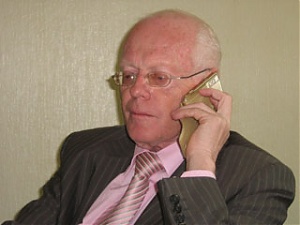 |
|---|
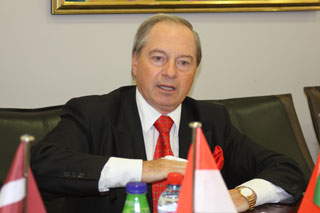
| Mr. Valdis Birkavs, former Latvian Prime Minister. |
Mr. Valdis Birkavs, former Latvian Prime Minister, presented a paper with the title “Latvian government is not fully aware of the crisis’ severity”. Referring to global experts’ opinion, the author argued that governments in the world, as well as that of Latvia, either did not comprehend (and actually did not realise the severity of the crisis) or deliberately concealed its real implications.
“I am still of the opinion that they are still not actually comprehending the situation because such things happen in the world for the first time and people do not have a sort of working methods to get out of crisis”, the former PM argued. And continued: “the more I think about the exit, the more it seems right to me that the best way out of crisis is to get to the bottom of it, in the first place. Otherwise the states –and the G-20 members among them- would not be in the capacity to elaborate some cardinal measures to change the whole banking sector and install control over it. In the most optimal scenario a completely transparent system must be installed in which there would be no place for tax havens, or for offshore-zones. Otherwise there would again appear some places to hide assets or to hide from tax authorities”.
In Mr. V. Birkavs’ opinion, the Latvian government must apprehend that at the crisis time one cannot behave as it could be in regular times.
The crisis, the former PM argued, is an exceptional, war-like period, and he suggested some advises to redress the critical situation. To begin with, he suggests, the number of people in government service shall be reduced. However, this is not to be done for the reduction purpose itself. There could be taken an example: the regulations in Latvian construction sector are taken over presently by four ministries (!). “In critical time, -and this is another ex-primer advise,- one has to be extremely operational and flexible in changing regulations, in watching over external competitors and promptly react on all changes. In order for the outright measures to take effect, argues former PM, the government people have to meet every day with those involved in real economy, i.e. businessmen, traders, people from financial and construction sectors, etc. in order to understand better the real situation, which they either do not know or do not comprehend”.
However, regardless of the difficulties facing us, he concludes, we have not used all the opportunities we possess in order to reverse the situation. All the decisions we are taking at present must be brave, innovative and quickly alternative, in case a mistaken one is taken, argued country’s ex-prime minister.
 |
|---|
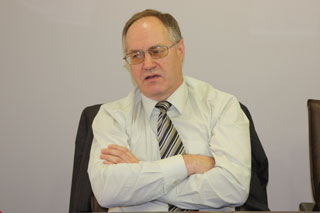
| Mr. Vitaly Gavrilov, Latvian Employers Confederation’s chairman. |
Mr. V. Gavrilov’s presentation at the RT was a report under the title
“Latvia needs now both a new development strategy and a recognised leader”
Latvian Employers Confederation’s chairman underlines that qualitative corporate management, as well as that of the national economy as a whole, needs both knowledge, management experience and lines of communications, or contacts. “We need a leader (I am the word’s fan), the man who can implement his ideas”, these is the opinion of a Confederation chairman with a rich administration and management experience at national biggest company Aldaris, several government agencies and professional associations. This is not what the present prime-minister can be proud of, argued Mr. Gavrilov.
To manage means, first of all, creating a model of management; it is the leader who has to propose one. However, the Latvian government does not have a model to manage national economy, neither has it a perspective development strategy, nor idea or national development system. In any development strategy certain force-major-situations have to be taken into consideration, including the critical ones. Without such a strategy the Latvian government, according to Mr. Gavrilov, is not really in the position to find out the ways out of crisis. At the same time there are both public organisations and intelligent people that know how to find these ways.
In this regard, Mr. Gavrilov is referring to Ministry of Economy’s working document where it was said that the ministry is responsible for the national economic management. However, he argues, neither this ministry nor anyone else in the country is aware of what exactly they are responsible for. For example in business management such situation is completely impossible. This is partially an answer to a question of why European funds are not really used in the country, and why innovation projects are difficult to implement.
 |
|---|
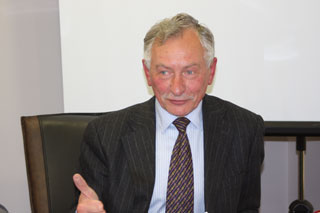
| Mr. Teodors Tverionis, Latvian Commercial Banks Association, Chairman. |
Mr. Teodors Tverionis underlined the importance of round-table discussions which took place for the first time in Latvian modern history. He resolutely supported the government’s efforts in critical management arguing at the same time that the government should not be treated as saving-everything “golden-bullet” instrument for entrepreneurs. However Mr. Tverionis regards as an inevitable necessity closer business connections with state management.
Mr. Tverionis agreed with the previous speakers that presently the quality of public management is below any critics. While referring to the popular notion that “the task of ruling the country is nothing special”, he underlined that the notion might be true if professional management advisers support “the ruling party”.
Mr. Tverionis touched upon the issue of state guarantees for financial sector and businessmen seeing them as very difficult for implementation, which banks would not be willing to be involved. He has firmly asserted that banks generally regard each project they support as a business-like project in which state guarantees did not play a free-way-role for acquiring the credit.
 |
|---|
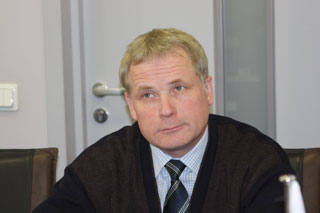
| Mr. Stanislav Buka, Chairman of the Board, Baltic International Academy, Dr. econ. |
Mr. Buka started his presentation with the acknowledgement of the fact that in the neighbouring Lithuania so-called “popular management” at a time of crisis had made a right choice: during recent elections in the country its people elected a professional manager for the head of state position, i.e. the new country’s President Mrs. Dalia Grybauskaite. Serving for several years as the European Commissioner for budget and financial programming issues, she has acquired good experience in management, economic issues and international relations.
According to Mr. Buka’s opinion, Latvian government should not be looked upon as a crisis management government; crisis management shall be an integral part of a “standard management”, the one that is to be elaborated for several years in advance. It has to be mentioned, he argued, that crisis management methods have become “standard” as well and they were well known.
In Mr. Buka’s opinion, “subjective factor” plays an important role in management; as a result, the entire set of negative factors effect the country’s economy, such as corruption, bribes and other aspects of shadow economy. Responding to Mr. Tverionis’ positive argument that “everyone must do his best”, he postulated that such argumentation could work mostly in stable economic situations. As to the “rules of the game”, Mr. Buka continued, they have to be known and familiar to everyone.
What is important presently, Mr. Buka argued, that the government has to create a kind of “security cushion” for the sectors in economy having great social effect, first of all, connected to medical service, foodstuff and consumer goods –all those sectors where small and medium enterprises are generally involved. The government’s task, however, is to provide adequate support for business at all possible levels and be very cautious about providing financial support for costly projects.
 |
|---|
| Mr. Anatolij Kovalenok, director, Vocational Training Centre –Ladens. |
Mr. A. Kovalenok suggested establishing a special state management high school for those interested in acquiring posts in public administration (presently, we have staff in Latvian public management recruited occasionally and often without background professional notion; in that case they can not be really responsible for their actions).
Another necessity, according to Ladens’ leader, is to create recruitment’s rules and standards for perspective state management staff, in particular the young ones. The primary task should be to establish competence criteria for all level of management, e.g. top-manager’s, as well as those in the middle ranks and sectoral managers. But first, we have to find out what capabilities and facilities they lack, or need, and provide adequate training.
Mr. Kovalenok is aware of the strong and literate manager’s best sides – complementary and assisting team of managers where each team-member explores his strongest capabilities thus compensating for his partner or colleague’s lack of adequate knowledge.
Special discussion theme was devoted to corruption in Latvia; two RT participants presented their reports.
 |
|---|
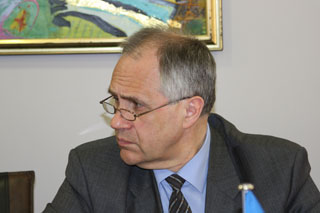
| Mr. Victor Morochin, Psychology High School, Riga, Dr. econ., docent. |
“Latvia needs an adequate corruption situation analysis” (Russian version of his report can be found in the Baltic Course magazine).
Mr. Morochin argues that people at various levels of management must be liable both morally and in civil court proceedings, as well as in criminal court, if the circumstances abide. These managers have to be accountable and liable for their actions and abstaining from actions (where necessary) in case the management system was damaged. A lack of manager’s personal liability for damage incurred by their actions or inactions could be regarded as a major factor leading to crisis, too.
“State manager’s competence, argues Mr. Morochin, shall include, besides theoretical background knowledge of social-economic management, such facilities as comprehension and skills. As to the former, such comprehension stems from personal experience in the functions of social-economic systems including peculiar aspects in these systems’ management. As to the latter, the skills’ development is based on the personal abilities to organize an efficient management in a society, the management based on acquired skills and personal qualities, concluded Mr. Morochin.
 |
|---|
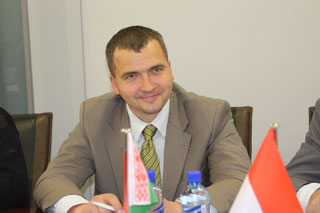
| Mr. Normunds Vilnitis, the head of Latvian Agency for Combating and Preventing Corruption, KNAB. |
Mr. Normunds Vilnitis suggested to have a look at the present state-of-art in country’s management with a “fresh eye”. Worst still, he argued, is the fact that Latvian society did not have adequate analytical information on corruption in political and private circles. And this is what the Agency intends to do, both in strategic and tactical aspects, he reaffirmed; the work will be completed within three or four months and the report will be submitted to the country’s prime-minister office.
Agency’s head underlined the fact that the country lacked a single remuneration system for civil servants; he reiterated that all the bonuses and rewarding system among the public servants in the government system shall be eliminated.
In a short reply to Mr. Vilnitis’ speech, Mr. V. Gavrilov pointed to the enormous number of state functional competences; he mentioned some 873 such functions, questioning whether a modern state really needs so many.
Another RT’s participant, Mr. V. Morochin raised his voice for the necessity to made public at least one investigation process involving civil servants’ wrong doings.
Some papers presented for the Round-Table discussions have been devoted to an acute political theme –Latvian capital city needs a real manager.
 |
|---|
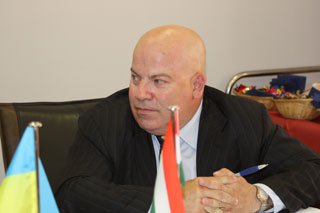
| Mr. Georgs Lansmanis, Entrepreneur, Latvia. |
Mr. G. Lansmanis, made his comments on the work of KNAB Agency saying that the Agency’s problem lies in the fact that it lacks real enforcement competences (nobody respects it anymore, he said). At the same time, he supported Mr. N .Vilnitis’ idea concerning elimination of bonuses in the state management. “The civil servants’ problem in Latvia is really quite big, Mr. Lansmanis said, we have been creating, so-called “our own management” –these servants were educated in our universities, they were accommodated to our problems and situations. As a result, we have had the public servants that did not believe in anything and who had no any value scale, at all”.
As a member of the team of the Riga City Council’s major candidate (Ainars Shlessers), Mr. Lansmanis explained that after examining the Council’s work they had realized that the Council had become “an ivory tower”; it was up to 80 per cent being completely independent in its decision-making. Mostly, the Council leads an uncoordinated policy, he added.
Mr. Lansmanis makes an example of Council’s “strategic decision”: Russian investment company –NCC- intends to construct in Riga port a modern container terminal. Instead of supporting the idea, the Council “suggests” NCC to build additionally two bridges in Riga (?). The result of such “actions” was evident – NCC abandoned the seemingly important investment project.
Mr. Lansmanis argued that both the prime minister and city head-managers have to learn taking full responsibility for their actions, and learn to share such responsibility among the management team.
However, he suggested to the Latvian government to be optimistic even at critical time and act –if necessary- even against IMF requirements; he argued that IMF quiet often made mistakes in their lending policies, the fact acknowledged in the world.
Mr. Lansmanis concluded that one of the biggest problems in Latvia lies in the fact that Latvians, in principle, do not like state power; he recalls it as a “farmer-syndrome”, which is making things even worse in the present critical situation.
 |
|---|
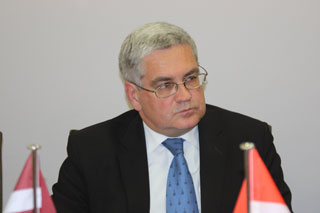
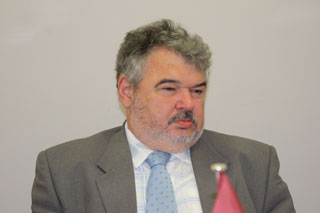
| Igor Graurs, JSC AMOPLANT, Director, International relations and Marketing Dept. |
Mr. Graurs’ remarks have been very interesting as he served several terms in the Riga City Council. Therefore, he supported people’s choice to elect Mr. Shlessers for the major’s post, as the City Council needs both a good manager and a strong personality. However, the future major would not and could not resist lobbying state interests in city’s development projects.
As to the way out crisis, Mr. Graurs suggested that the stakeholders involved in crisis management have to start intensive internal negotiations: they have to define those economy sectors that could assist in overcoming the crisis. In Mr. Graurs’ opinion, these economy sectors in Latvian situation are transport and transit.
He argued that service sector’s potentials were greatly under valuated: therefore, VAT increase to 21 per cent in restaurant and hotel service sectors resulted in tourists’ routs turning to Estonia and Lithuania as cheaper places to stay. Similar negative effect VAT increase has had on publishing industry: on one side, people would read fewer books, on another, the number of books printed in Latvian would diminish. Reading becomes an exclusive habit due to growing books and papers’ prices, Mr. Graurs concluded.
 |
|---|
| Mr. Pavel Baranaj, Slovak Embassy in Latvia, Trade and Economic Section, Second Secretary; Member of Diplomatic Economic Club. |
Mr. Baranaj started his speech with explaining Slovak motorcar construction experience: during Slovak independence years, three big auto-car construction companies have been created. There are presently about 80 thousand people working there, he said. US motor companies expect to produce in Europe about 1 mln cars in 2011-2012, the German companies –VW, for example, intends to produce 400 thousand cars.
VW subsidiary in Bratislava was not really affected by the crisis; the “working instrument” to avoid crisis was so-called flexicont, i.e. employers work less hours but get the same salary, in exchange for obligation to work over-hours when the situation changed to the better. This factory in Bratislava was the first one where the EU has accepted the flexicont- model. Although Bratislava car factory produces big and expensive cars (Skoda Octavia, Audi Q 7 and VW Touareg) exported to Germany, US, Russia and China the cars are popular in these countries.
Reflecting on measures, which would be most helpful both to economy growth and to businessmen, Mr. Baranaj cited he words of the VW Bratislava board member, Bogdan Vojner: “It is good that we have created some security cushion during better economic conditions; now at a critical time it really helps. However, besides industrial infrastructure, it is important that we have a flexible labour market that helps in workers’ movement to the places where they are mostly needed. Another important thing is that a good education system is created in Slovakia, alongside the high education level”.
According to Mr. Baranaj, it is important that there is a program in Slovakia to assists the protection and development of investment activity: “We are striving both for the attracting investments and for them to stay due to favorable protection climate that would facilitate investments in the long run. This program addresses quick and flexible reaction to investors’ problems and quickly eliminates both existing barriers through comprehensive assistance and stimulates entrepreneurship”.
One of the most significant recent investments in Slovakia for the last several years was a factory in Trenchin, a city in Western Slovakia. All difficult issues on the way to the factory’s construction have been eliminated and the construction successfully begun providing employment for about 3 thousand people in the near future.
“One thing is pretty clear, concluded optimistically head of Slovakia’s trade council in Latvia, worrying about the things would hardly help; everyone has to fight for his chance”.
Risk management: concept, positioning and priorities
 |
|---|
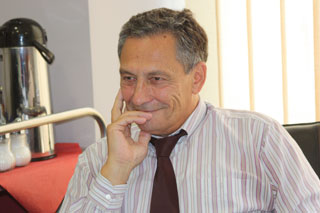
| Dr. Eugene Eteris, European Studies Faculty, RSU, LLD, assoc. prof. |
Mr. Eteris devoted his paper to risk management (RM) concept and practice on the international level and within the European Union. Present crisis, he acknowledges, has shown that RM was not taken seriously enough neither in the general state economic strategies neither in its financial sector. The hampering factor – that financial sector has become an independent sovereign in economy – only worsened the situation. In the Baltic States the RM has not been treated as one of the important aspect in making economic models. The author ascertains that RM is both in the theoretical “decision vacuum” and in need for international and European regulatory authority.
This complicated sphere is clearly seen in the Yahoo website: there are more than 473 mln (!) hits on “risk management”, more than in such key word-categories as “peace” -with 116 mln- and “freedom” - with 96,5 mln hits (data from end of April 2009).
Mr. Eteris postulates that for the first time the RM was “seriously” addressed in May 2007 when a special report on RM was published in Financial Times. A couple of interesting conclusions appeared: first, modern economic development created a new set of risks (more complicated and system-like than was expected before), and, second, an optimal market based RM shall be installed for a market-based valuation of bank’s credit portfolio and in “public” assessment of national development models.
The author attempts to show that modern crisis has a systematic character, which has made it extremely difficult to predict and properly assess, hence the present outcomes. However some analysis can make the future risk assessment a more foreseeable and predictable task: the successful approach would challenge conventional thinking in risk management.
Three aspects of modern RM concept have become important in Europe and the Baltic States’ management:
- first, that the RM must warn or alert senior executives on possible risks and unexpected problems facing the business or/and public entities;
- second, that the RM is to identify foreseeable risks, and
- third, that the RM must assist in managing all sorts of such risks, foreseeable of course, in the first place.
The author argued, that in the circumstances when the banking and financial sectors are quite separate from important public decisions, it would take a long time for regulators to respond. However, one step in a process of regulatory reform has been already taken: Committee of European Securities Regulators recently released “consultation statement” on RM principles for Ucits, European retail fund structure. The next move would be to install the RM function into financial service industry.
Mr. Eteris has cited the EU Commissioner for competition, Neelie Kroes, who acknowledged in Financial Times, April 27, 2009, that “in recent years, the banking system and financial investors wanted too much, too quickly. Too much risk was taken with other people’s money, with dramatic systemic consequences: more than €3,000bn ($3,940bn) of other people’s money – that of taxpayers – has now been used to pull banks out of the hole they dug for themselves”.
European banks cannot set aside the Union rules, said Neelie Kroes, pointing out that this was the “muddled thinking”. Instead, stability should have come first in order to safeguard citizens’ savings and proper financing the economy. Without taking into account control hazards, present stability has come at a very high price.







 «The Baltic Course» Is Sold and Stays in Business!