Ecology, Energy, EU – Baltic States, Forum
International Internet Magazine. Baltic States news & analytics
Tuesday, 09.06.2026, 06:36
Baltic Sea Action Summit shows the way
 Print version
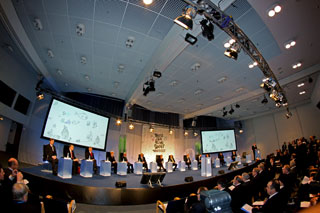
The Baltic Sea Action Summit in Helsinki, convened by Finnish President Tarja Halonen, Prime Minister Matti Vanhanen and the Non-Governmental Organisation (NGO) "Baltic Sea Action Group" opened in Helsinki on February 10. Johannes Hahn, the new European Commissioner for Regional Policy attended the summit with a inaugural address.
Key participants
 |
|---|
This high-level event will bring together several EU Heads of State or Government, as well the Russian and Norwegian Prime Ministers. The purpose is to encourage key stakeholders – governments, business leaders, and NGOs – to make concrete commitments to save the Baltic Sea from further deterioration.
Other key participants taking part in the Summit include the Swedish King Carl XVI Gustaf, the Lithuanian President Dalia Grybauskaitė, the Latvian President Valdis Zatlers, the German Federal Chancellor Angela Merkel, the Estonian Prime Minister Andrus Ansip, the Russian Prime Minister Vladimir Putin and the Norwegian Prime Minister Jens Stoltenberg.
The next conference will be held in Tallinn on 14-15 October this year.
Commission’s opinion
“The success of the EU Strategy for the Baltic Sea Region cannot be taken for granted. It will require hard work and sustained commitment at every level across the region. We count on all stakeholders on the ground to boost the region’s competitiveness and to cooperate in tackling the challenges in the field of environment. I also look forward to working with our Russian and Norwegian partners on areas of common interest and concern”.
EU Commissioner for Regional Policy, Johannes Hahn, speaking ahead of the event
Actions and actors
In October 2009, EU Member States agreed on a comprehensive European Strategy for the Baltic Sea Region with the aim of better coordinating their efforts. Following the major enlargement of the EU in 2004, eight of the nine countries bordering the Baltic Sea have become the EU members: Sweden, Denmark, Estonia, Finland, Germany, Latvia, Lithuania and Poland).
The four cornerstones of the “Baltic Sea strategy” set out to address the challenges facing the region are the following:
- to improve the environment in the Baltic Sea Region. The state of the sea is deteriorating due to excessive discharges of nitrates and phosphates and biodiversity is under threat;
- to increase prosperity through more balanced economic development by, for instance, promoting innovation through small and medium enterprises;
- to make the region more accessible and attractive through improving transport links and energy security;
- to make the region safer and more secure, by, for instance, combating cross-border crime and improving maritime surveillance.
The EU Baltic Sea Strategy is accompanied by an action plan identifying 80 flagship projects each with a designated lead partner, and a timeframe for completion. Issues to be tackled at the summit, range from eliminating the discharge of sewage from ships, to creating marine protected areas, setting-up a fund for innovation and research, or better connecting Warsaw to Tallinn via the Rail Baltica. See BC article.
All invitees of the Helsinki Summit, representatives from governments, regions, cities, NGOs, businesses will make their own commitment to action, which can be financial or non-financial in nature as long as it contributes to the recovery of the Baltic Sea. So far, over 110 commitments have been generated from organisations including IBM, Lloyd’s, Siemens, St. Petersburg wastewater treatment plant, the Swedish Shipowners Association, and the port of Klaipeda (Lithuania) amongst others.
More information on the following EU websites:
http://ec.europa.eu/regional_policy/cooperation/baltic/






 «The Baltic Course» Is Sold and Stays in Business!