Analytics, Baltic States – CIS, Direct Speech, Latvia, Legislation
International Internet Magazine. Baltic States news & analytics
Tuesday, 09.06.2026, 13:19
Edward Lucas: organizers of referendum achieved their goal of polarizing Latvian society
 Print version
 |
|---|
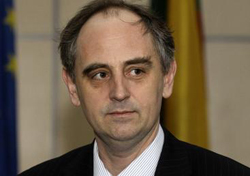
| Edward Lucas. |
''Nobody expected the referendum in Latvia on making Russian a second official language to succeed. But if the organizers wanted to polarize Latvian society, they may count the result as a success,'' Lucas points out in an article, informs LETA.
''It revived long-standing disagreements about history: was Latvia "occupied" by the Soviet Union in 1940, or merely "annexed", or simply "incorporated", and with what degree of legitimacy? Are the mainly Russian migrants of that era "occupants"? Has Latvia, which returned to the map of the world in 1991, been amazingly generous in allowing them to stay, or despicably stingy in not giving them automatic citizenship?,'' Lucas asks.
He points out that ''in practice, Latvia is a kind of bilingual society, with some awkward assymetries. Almost all ethnic Latvians (around two-thirds of the population) know at least some Russian, though they may resent speaking it. Some Russians have Latvian citizenship anyway, if they or their ancestors were citizens of the pre-war republic. Others have adopted Latvian citizenship enthusiastically (as of April last year the number of naturalizations was 135,840). Others are bilingual but refuse to consider applying for citizenship; others defiantly refuse to speak Latvian at all, even after 22 years of independence''.
''There are other quirks too: the language people speak at home is not necessarily the same as their declared ethnicity; Latvia has plenty of mixed marriages (unlike neighboring Estonia). Some people who are nominally part of the Polish, Belarusian and Ukrainian minorities may be Russophone in practice,'' Lucas writes in ''The Economist'' article.
In recent years the language issue has been off the boil. International human-rights bodies have largely accepted the Latvian argument that having some sort of language hurdle for citizenship is justified. The number of non-citizens (around 300,000, or one in six of the population) is in slow decline, though more because of demography than naturalization, which has slowed to a trickle, the article points out.
''The referendum has pushed the issue up the political agenda, and entrenched Latvian fears of assimilation and intimidation by the big eastern neighbor. They fear that the local Russians (and Russia itself) regards Latvian independence as a temporary aberration. Russia does little to counter that impression: its Russia Today television channel habitually smears Latvia (and Estonia) as Nazi-loving ethnocracies,'' Lucas points out.
The article says that Latvia's neighbors are worried too. The Estonian MP Marko Mihkelson said: "Russia's official position, in which it does not recognize the results of the referendum as fair, unfortunately convinces us that polarization and deepening of internal tension in Latvia are in Moscow's interests."
Lithuanian commentator Rimvydas Valatka expressed a similar point of view: "The central issue is the fact that such a referendum, so humiliating to Latvians, could take place in a NATO and EU country in the first place. Instead of encouraging Latvian Russians to accept reality and integrate, Russia continues to pit part of the population against the Latvian state," he says.






 «The Baltic Course» Is Sold and Stays in Business!