Book review, Economics, Education and Science, EU – Baltic States, Integration
International Internet Magazine. Baltic States news & analytics
Tuesday, 09.06.2026, 14:20
European Integration: Reflecting Constant Clash between Politics and Economics
 Print version
 |
|---|
The pursuit for closer integration has for decades been the main drive in the European idea, both politically and economically; it was most often quite successful. For example, dimensionally, the integration went pretty well from the Communities of initial six into presently a Union of 27 member states within just five decades. As to the economics, the “common market” integration has successfully transformed into such spheres as defence, security, foreign affairs, etc. All these aspects along integration paths would be unthinkable 50 years ago.
The collection of works is arranged in four sections aimed to cover the EU “foundations and perspectives”. First section is devoted to the European integration’s “constitutional architecture” including such issues as “politics of European reason” and voting in the Council, Comitology, the role of Court of Justice and fundamental human rights.
In the core book’s second section on integration, some challenges and “boundaries” of the process are covered. Thus, for example, the problems of reconciling integration with differentiation are analysed (A. Ott), as well as member states’ “conditionality” in integration (K. Inglis), enhanced cooperation and flexible approaches to it (M. Dougan).
The EU enlargement issues and that of neighbourhood policy are discussed in the third section, while “the EU and the world” - in section four. The main contributors in the latter section are a couple of scholars from Columbia and one from each of Thailand and Argentina.
Covering the EU integration issues development (Section 2) seems to be the main part of the articles’ collection, though it covers less than one-fifth of the book.
Determined and coordinated
Looking back into Europe’s history, one becomes aware of the changing priorities in politics and economics of “integrational development”. Thus, in the initial EEC Treaty (1957) there were less than a dozen of “integrating policies” while presently there are more than 30. The “simple idea” of common market has turned into a full-scale cooperation in several “unions”, e.g. monetary, agriculture, customs, etc.
Some new integration spheres have occurred since: foreign and security policy, justice and fundamental rights, citizenship and climate action, to name a few.
The EU is determined to be a major player in the modern world: the new EU-2020 Strategy has clearly revealed the common member states’ approaches and decisions. At the same time, the EU-27 is working hard to find better steps in “confederation efforts” within integration. The European Union has been always an “integration pursuit” among independent and sovereign states. Although no country can any longer claim full sovereignty, the essence of cooperation provides more and reliable impetus to coordinated actions.
EEC’s founding fathers were dedicated marketers in pursuit of economic policies, i.e. there were constantly more politics than economics. As to the former, it represented the essence of coordination efforts while the latter has been mostly the domain of national governments. Only now, after 50 years of integration can we say that political union is really claiming its rights. The fact, which is extremely important to remember as it is practically of no avail to force sovereign states (at least the big ones) to join policies against their will.
German’s impetus
It happened that the German government hosted the festive events concerning the 50th anniversary of the EEC Treaty, holding EU rotating presidency in the first half of 2007. The Declaration on that occasion carefully elaborated by the German’s presidency, has shown the spirit and mood among the member states towards both the state-of-art and perspectives of European integration+).
+) http://www.eu2007.de/en/About_the_EU/Constitutional_Treaty/BerlinerErklaerung.html
As it goes from the 2007 Declaration, the EU member states confirmed, that “hope of peace and understanding” in Europe has been fulfilled and that the EU citizens “have united for the better”. The latter means “mutually supportive cooperation”, which enables the Union “to strike a fair balance” between the EU member states’ interests; of course, both in politics and economics.
The Declaration postulated, that “we preserved in the EU the identities and diverse traditions of its members”. It clearly indicated that the EU had not been ready for constitutional-type coordination and cooperation, the fact that later on was underlined in three states’ negative referenda on the “Constitution for Europe”.
Economic issues in integration
The European economic policy is changing tack in the ocean of globalisation. The new Treaty of Lisbon (2007), which took almost ten years for the EU member states to elaborate, is aimed to navigate the Union through the economic tempest of the 2007-10 crises, providing for changes in internal and external aspects of European economic development.
Some of these integration perspectives have been already evident at the time of the books’ preparation (December 2008) though did not materialize.
The EU presently has prepared a new economic plan for a new decade of 2010-20. During the first decisive months in 2010, the European Union's institutions together with the EU-27 member states have elaborated the new ten-year’s economic plan aimed to combat recession and drafted a new European course towards steady growth and employment. It is becoming a practical implementation of the ideas embodied in the EEC Treaty.
The EU has become an important force on a global scene: with one-fifth of the global GDP, more than 30 per cent in the global trade and 40 per cent of global exports, 25 per cent in world share of R&D and about 7 per cent of global population. These assets can make it easier for the EU-27 to become a leading partner in the competitive world.
The clouds of “constitutional treaty’s” failure are hanging over the major parts of the articles’ collection. Of course, the CoJ’s judgement in 1986 describing the EEC Treaty as a constitutional charter assists greatly in supporting that type of arguments. However, first, the member states rejected the CoJ’s references to a “charter” and, second, the idea of such a charter in the form of a “constitution for Europe” was of no avail either.
The book’s pervasive adherence to “constitutionalism” has often lead to misjudgments, e.g. in the foreword CoJ’s advocate general, M.P. Maduro argued, that “the lesson to be learned ought to be that constitutionalisation needs to be either in a functional manner… or by differential integration” (p.v). It is not clear whether the “differentiation” means “less Union”.
New signs of development and the new economic order
The single market has been the main achievement of the more than half a century of European integration. Paradoxically enough, those EU members outside the eurozone (e.g. the UK, Sweden, Denmark, and the newer EU members) have been (and probably are) the most enthusiastic supporters of the single market.
The Lisbon Treaty has shown that after fulfilling the main economic targets of European integration, another Union’s strategy appeared heading towards deeper political integration.
This assertion has led to main changes in the wake of integration focusing the essence of “integration” on a closer cooperation and coordination within the EU’s confederation structure.
The EU in the coming decades, most probably, will make far-reaching changes in its politics and economics in order to combine divergent member states’ expectations and making common efforts to confront the global challenges. Hence, the new economic order in the EU is a necessity, which cannot be ignored anymore.
The EU lessons and perspectives
The book’s conclusions cover recommendations concerning so-called outside the EU issues (“the EU in the world”) rather than the ones inside the EU. It is not disappointing, though the readers, to my mind, would prefer something more challenging to provide answers to the present economic crisis.
The “lessons from the EU”, as P. Nicolaides called it (p. 437-445), sound quite trivial: may be because the book’s conclusions on perspectives are based on references from 2005-07 (since then a lot has changed in politics and economics of integration).
Three “lessons” are attributed to the EU success, argued Mr. Nicolaides. It is, first, commonality of policy objectives, i.e. the desire to eliminate barriers between the member states’ economies. Second, it is a drive towards strong supranational institutions (the author still pointing to the need to “establish common institutions with sufficient powers”). And third, it is about compliance with the “common rules”, the system that is based on the EU courts, the role of the Commission and the EU’s directly applicable laws. I wander, haven’t all these been the Communities and the Union’s main background since the time immemorial?
The European Commission financially supported the research and publication project devoted to the 50-years of European integration. The Dutch scholars, who initiated the project are all those from the Maastricht University (both editors are from its law department) as well as from the Netherland’s European Institute of Public Administration (P. Nicolaides and E. Best), supported by the country’s European Affairs Minister, Frans Timmermans.
Out of 25 scientists invited to the project, 11(!) represent, I would say, “the Maastricht integration school”, with additionally 6 scholars from the UK, two from France, and one each from Italy and Belgium.
Editors’ geopolitical choice of authors from only five EEC “founding fathers” is out of any proportions: neither German scholars were invited, nor any other academics from the recent enlargements. At the time of 50-years’ jubilee in March 2007, the new 10 EU member states have been in “integration” already for more than three years. It would be interesting how these countries assess their participation in the process. It would be good, among other things, to follow the EU “perspectives” –the second key word in the project – which lacks a sufficient backing. Needless to say, that editors’ biased inclination in “capacity’s choice” (geographically and sectorally, mostly towards legal disciplines) leading to insufficient regional coverage makes the book less attractive to professionals in European studies.
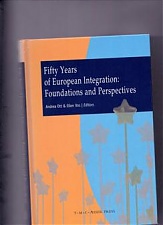
*) Fifty Years of European Integration: Foundations and Perspectives. (Eds. A.Ott and E.Vos).-T-M-C_Asser Press, The Hague, The Netherlands. 2009. –xxiv, 455 pp.







 «The Baltic Course» Is Sold and Stays in Business!