Baltic States – CIS, Economics, The Baltic Course No. 27
International Internet Magazine. Baltic States news & analytics
Tuesday, 09.06.2026, 08:04
Belarus: familiar though unknown country
 Print version
 |
|---|
The trip was organised by the Belarus Embassy in Latvia in cooperation with the “D.V.I.N.A.” association. During four days the journalists visited cities - Grodno, Minsk, Vitebsk, Polotsk and Novolopeck; we met with local authorities, visited several companies, special economic zones (SEZ), cultural events and tourist attractions. The program of our visit was huge and interesting; below comes some reminiscences of the trip.
New development stage
According to the World Bank data, Belarus economy experienced stable growth since 1996: during these years country’s economy on average has grown by 6.6 per cent a year. In the last four years the Belarus economy growth reached 9-11 per cent a year (in 2006 the growth rate was 9.9 per cent and direct investments increased by 31.4 per cent). Already in the first quarter of 2007 the growth rate was about 8.7 per cent and investments’ growth reached 25,1 per cent.
According to experts’ opinion, the country’s economy has presently reached a new stage in its development. Therefore, to sustain further economic growth the country needs to reinvigorate its industrial potentials. So far huge investment programs (calculated in million dollars) have been concentrated on big industrial companies with the controlling shares owned by the state.
When visiting various Belarus industrial sites, e.g. azoth-company in Grodno, milk-factory in Grodno, carpet plant in Vitebsk, etc. we could see that the modern technologies and management systems have been explored extensively. Average wages in industry are at the level of 600 USD; quite remarkable is the fact that the management staff’s salary cannot be higher than 3.5 times that of the workers.
Urgent problem: growing gas and oil prices
As local administrators and CEO in companies acknowledged, the “gas and oil issue” is the most sensitive and discussed one in Belarus. This august IMF published a report underling that the GDP growth in the country in the great extent “depends on adequate price level for the Russian energy resources”. In case the prices for energy resources will go up, the country can experience about 10-15 per cent reduction in GDP up to 2012.
At the same time, experts in IMF have confirmed evident country’s achievements in economic development due to the fact that “the country managed to re-distribute through national economy” all the profits that it could get through the favorable price level on Russian utilities.
The country has presently adopted the national program for energy saving, which is covering industrial companies, public administration and other users of resources; for example, old bulbs are changed into modern and more efficient fluorescent-type bulbs.
Naftan’s refinery survival strategy
We visited one of the main country’s company - Naftan-refinary, a joint-stock company built in 1963 according to international standards. This is what Narftan’s deputy chief-engineer, Vjacheslav Zubovich said during press conference: “the new set of equipment installed during 1999-2003 was the final stage in the company’s refinery modernization program. As a result, we can produce diesel petrol with the low sylphur-contents of up to 0,001%, which is required by the Euro-5 petrol standard”.
The company’s general-director, Vjacheslav Yakushev continued: “the present Naftan-program for 2005-2010 would allow us a deep processing of about 12 mln t of crude oil a year with the final products in full consistence with the European standards. At the same time we’d modernize both the company’s infrastructure and energy use. All these positive changes can be performed due to high quality of our final production, i.e. diesel petrol which is the company’s main export item. About 70 per cent of Naftan’s diesel is exported to the European Union’s member states”.
Naftan’s management staff can not hide the truth that company’s productivity is lower than that of the similar western refineries; in particular, after Russian’s recent price increase the productivity dropped 10 times! Naftan’s products can be competitive on a global market only due to cheat labour force (about 800 USD a month) and a cheap Ural crude oil. Increasing efficiency measures would force the company to sell expensive social infrastructure either to the local authorities or to the state. As to the company shares’ trading, Mr. V. Yakushev said that about 99.8% of company’s stocks belong to the state and only the state can decide how to deal with the shares.
Stable investments
According the EBRD’s recent report, Belarus has the lowest among the SNG-states share of inefficient “business-assets” resulting from bureaucracy red tape and criminal environment. The share of population living below the poverty line is less than 2 per cent (11% in Latvia, 6.9% in Lithuania, 7.5% in Russia and 31.4% in Ukraine). The country allocates 4.9% of GDP for health protection, which is the highest share among the former Soviet-block states; it has one of the highest among the SNG states share of GDP devoted to education — 6.1%. Average salary level in Belarus was about 300-500 USD a month.
Local authorities underlined the urgency to re-assess the role and importance of private business in social-economic development. It was acknowledged that the share of population involved in GDP growth shall be increased, generally, at the extensive additional growth of the new private undertakings.
In this regard, Belarus provides a “green light” for investors, both within the SEZ territories where the companies can get numerous reductions in custom duties and taxation, and in commercial and tourism sectors.
Journalists visited the SEZ “Grodnoinvest” which was established in 2002 and composed of four land plots with a combined territory of 1045.9 hectares. 39 national residents are already established there. The SEZ land for potential industrial construction occupies 351 hectares and is available both in the Grodno city and in the surrounding region. The information on new tenders can be found on the administration site: www.grodnoinvest.com.
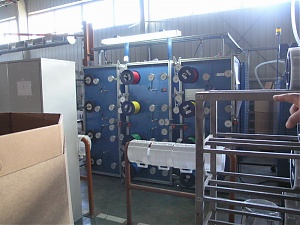
The journalists visited three companies in the Grodno’s SEZ. Thus, Belarus-USA joint venture closed stock company Bigan is involved in sausages coverage foils production with flex-printing; 84 per cent of company shares is owned by the American side. The company’s premises occupy 1446 hectares and it employs 24 people. Each month about 1500 km sausage foil is produced.
Belarus-Swedish company Elephant & Co (51 per cent is controlled by the Belarus side) is involved in reparation of buses and trucks with 60 people employed.
Recently, a canned-food factory Grodfood was opened by a Belarus-Polish joint venture with 120 workers (99 per cent is owned by the foreign capital).
Due to its favorable geographic situation, SEZ “Grodnoinvest” expects investors from the Baltic countries. So far only two companies are working here: Lithuanian Edmundas & Co which is involved in menswear production and an Estonian Rosetta Group which produces furniture.
Another SEZ “Vitebsk” was established in 1999 for 30 year-term and on 1091.7 hectares territory. As the administration head, Mr. Leonid Shevchenko underlined, there were 31 resident registered in the SEZ and there were 337.4 hectares of free plots available for the new construction projects. More information on: www.fez-vitebsk.com.
Unfortunately, the Baltic states are yet among serious investors though SEZ “Vitebsk” representations exist both in Lithuania and Estonia. The share of Lithuanian investors is just 2.2 per cent, the rest belongs to British businessmen (20.6%) Russians (20.6%), Germans (15.9%), USA (17%), etc. There were once a Latvian company in the SEZ “Vitebsk” but about 3 years ago it was closed.
Potential investors are welcomed to the newly renovated amusement Augustus Channel Park (with 18 mln USD used for that purpose) with several tidy islands and tourist boats. The adjacent lands on both sides of the channel are still available for construction of hotels, Spas, and attraction complexes. Some Latvian companies have already showed their interest. For example, there are two vacant premises in the Minsk Trade Center for future shops and its administration will be glad to welcome goods from the Baltic states. In short, Belarus is opened for cooperation.
The Baltic Course 27, Autumn 2007







 «The Baltic Course» Is Sold and Stays in Business!