Ecology, Energy, EU – Baltic States, Forum, Legislation
International Internet Magazine. Baltic States news & analytics
Tuesday, 09.06.2026, 13:21
Good beginning with plausible optimism in “Hopenhagen”
 Print version
The two-week meeting, the fifteenth Conference of the 193 Parties to the United Nations Framework Convention on Climate Change (UNFCCC) and the fifth meeting of the 189 Parties to the Kyoto Protocol, is the culmination of a process set in motion in Bali, where Parties to the UNFCCC agreed to conclude negotiations on a new global deal in Denmark in 2009 (see our report from COP-15, 6 December 2009 in the BC).
Promising statements
 |
|---|
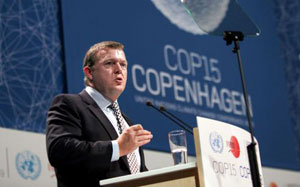
| Lars Løkke Rasmussen. |
According to speakers at the opening ceremony, the highly anticipated conference marks an historic turning point on how the world confronts climate change, an issue with profound implications for the health and prosperity of all people. Danish Prime Minister, Lars Løkke Rasmussen announced that 110 heads of state and government would attend the closing part of the conference and in making its final concluding document. The Danish PM acknowledged that the climate changes transcend state borders: these changes do not discriminate, they affects us all, he said. “And we are here today because we are all committed to take action. That is our common point of departure – the magnitude of the challenge before us is to translate this political will into a strong political approach,” he concluded.
The urgency to act was underlined by another speaker, Dr. Rajendra Pachauri, Chair of the UN Intergovernmental Panel on Climate Change (and director of a couple of environmental institutions), who told the conference that global emissions would need to peak by 2015 for the world to stay below a two degrees Celsius temperature rise. “The costs of responding to climate change will become progressively higher as time goes on, therefore we must take action now,” he said.
The newly elected COP-15 President and Danish environment and climate Minister, Ms. Connie Hedegaard was worried about the fact that “the world has reached the deadline and there is no going back”; Copenhagen will be the city of the three C’s: Cooperation, Commitment and Consensus”. Now is the time to capture the moment and conclude a truly ambitious global deal. This is our chance. If we miss this opportunity, we will not get a better one,” she concluded.
UNFCCC Executive Secretary Yvo de Boer said there was unprecedented political momentum for a deal; world leaders are gathering in Denmark ready to make an agreement that offers serious emission limitations and providing significant financial and technological support to developing countries. “At the same time, he said, COP-15 will only be a success if it delivers significant and immediate action that begins the day the conference ends”.
According to the UN’s top climate official, negotiators must focus on solid and practical proposals that will unleash prompt action on mitigation, adaptation, finance, technology, reducing emissions from deforestation in developing countries and capacity-building.
Yvo de Boer spoke of three layers of action that governments must agree to by the end of the conference: fast and effective implementation of immediate action on climate change; ambitious commitments to cut and limit emissions, including start-up funding and a long-term funding commitment; and a long-term shared vision on a low-emissions future for all.
According to the Intergovernmental Panel on Climate Change, an aggregate emission reduction by industrialised countries of between minus 25% and 40% over 1990 levels would be required by 2020 in order to eliminate the worst effects of climate change, with global emissions falling by at least 50% by 2050. Even under this scenario, there would be only a 50% chance of
avoiding the most catastrophic consequences.
Eight days before the final decision
The UNFCCC working groups starting Monday will have six days to conclude negotiations before the Ministerial High Level Segment starts 16 December. Ministers will then in turn have two days to take any unresolved issues forward before the more than 100 world leaders arrive the evening of 17 December. This means a total of eight negotiating days to prepare a workable package that consists of both immediate and long-term components, which leaders can endorse on 18 December.
An important initiative
The European Union has shown again its leadership in tackling climate change with the European Commission announcement that the number of signatories to the Covenant of Mayors on sustainable energy has reached 1000. The German city of Rostock became the 1000th signatory and is now fully committed to going beyond the EU 20% reduction target for CO 2 emissions, the Commission announced in COP-15.
This milestone marks ten months of exceptional growth for the Covenant of Mayors’ initiative, as the number of local authorities participating has almost trebled since the first signing ceremony in February 2009.
“It is in the cities and municipalities that daily life is organised on a local democratic basis, said Karina Jens, President of the Rostock City Council. We understand the sustainable use of natural resources includes the management of forests and green spaces in the city as well as the efforts deployed in all the fields of environment protection and the greater use of renewable energies”.
Rostock lies on the Baltic Sea coast and with a population of 200,000 is a university city and the largest city in the north German state of Mecklenburg-Western Pomerania. Since 2006, the city has systematically applied a framework concept of climate protection that has already reduced CO 2 emissions from 7.5 tones/capita per year in 1990 to 4.1 tones today. The average figure for Germany is now at 10tonnes/capita and for the EU-27 at 9 tones/capita. The city’s long-term goal is a reduction to 2 tones/capita.
Key actions include:
- Targeting a completely fossil-free energy supply with energy supplied from the region;
- Extending use of combined heat and power (CHP) for district heating through a system that already covers 70% of the households;
- Doubling of the tram network from 21 to 38km over the past decade, ensuring 80% of the population is within 300m of services;
- Improving the bicycle friendliness of the city; and
- Encouraging sustainability in the 6000ha of Forest Stewardship Council ( FSC ) certified forest within the city boundaries – the largest single wooded area along the Baltic coast.







 «The Baltic Course» Is Sold and Stays in Business!