Analytics, Education and Science, Energy, Latvia
International Internet Magazine. Baltic States news & analytics
Tuesday, 09.06.2026, 05:24
Innovative financing schemes for building renovation in Latvia
 Print version
These barriers respectively are:
- lack of knowledge and experience in common property management;
- low incomes and fear to take the credit;
- inability of residents to agree and make common decisions and lack of trust in realization of a successful project;
- lack of knowledge in this kind of project realization.
Several innovative financing schemes have been developed to overcome these barriers. The schemes are described in detail below:
- Building manager plays a role of an intermediary in the process of energy efficiency measure implementation;
- Heat supply company provides financing in the process of energy-efficiency measures implementation;
Building manager as an intermediary
Figure 5.1. shows the operating principle of this financing scheme. General meeting of the apartment owners authorizes a building management company to take all necessary actions related to energy efficiency measures in the building including tendering and contracting for energy audits, development of technical project documentation, construction works, or accepting financial offers such as commercial loans or state and / or municipal co-financing. This means that the building manager prepares and signs all necessary documents on the basis of the apartment owners issued delegation of authority, but does not have any financial obligations for loan redemption, since he/she only acts as an intermediary, not as a borrower. That implies that ongoing financing redemption period is not an obstacle in case if the general meeting of the apartment owners decides to change the building manager since the apartment owners are the borrowers themselves. Loan payment for energy efficiency works is included in the monthly costs for management.
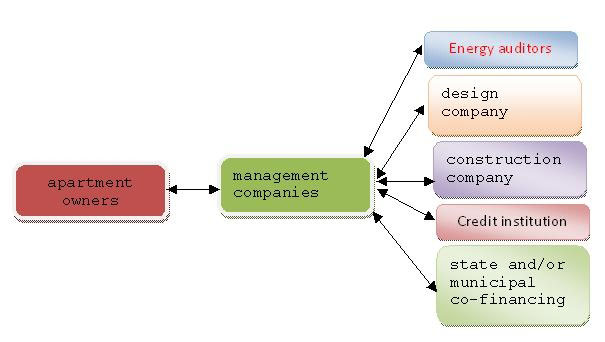 |
| Figure 5.1. Operating principle of the financing scheme where building managers act as intermediaries |
This main advantages of the financial schemes:
- building managers have the knowledge and experience in management of common ownership, in performing various building works and their supervision, and performing and evaluation of tenders for various services and works, as well as have the resources that are necessary for these activities;
- residents and the manager are familiar to each other and collaboration is formed based on the mutual trust that has been developed for many years;
- the building manager knows most of the apartment owners, so it is more possible to convince them about the necessity and effectiveness of the energy-efficient project implementation.
Lack of these schemes appears in those cases when the apartment owners and the building manager have developed strong distrust during many years. Then it is very hard or even impossible to implement the developed scheme on practice.
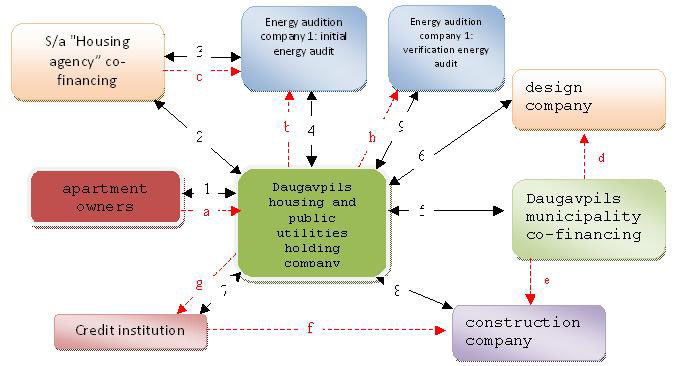
Only a few energy-efficiency projects have been implemented in Latvia according to this scheme. One of these projects has been implemented in Daugavpils, where the building manager “Daugavpils housing and public utilities holding company” as an intermediary implemented all activities related to energy efficiency measures. Figure 5.2. shows the project implementation scheme.
 |
|
Figure 5.2. Scheme of energy efficiency measure implementation in Daugavpils, 38a Vienibas street (solid line arrows indicate contractual relations, dashed line arrows indicate cash flows) |
In 2005, "Daugavpils housing and public utilities holding company” that manages the buildings in Daugavpils located at 38a Vienibas street (1) ordered an energy audit for the building, signing a contract with the state agency" Housing Agency "(2.3), and obtaining a partial co-financing for its performance (b and c).
After the energy audit was performed representatives of the management company’s arranged several meetings with apartment owners until most of them agreed to initiate energy efficiency measure implementation using commercial loan and municipal co-financing. Before the works started the management company opened a tender and chose the winning companies for project development (6), conduction of construction works (8), and financing (7). Also, an agreement with the Daugavpils city council was signed for 20% financing of the total project costs for construction works (5) and 100% technical support for project development (d). The total implementation costs were covered by commercial loan (80% of the total cost), (f) and municipal co-financing (20% of total costs) (e). Apartment owners make monthly payments for building management costs that include loan payments to the building management company’s account (a). The management company settles regular loan payments with the bank (g). Upon completion of the construction works building manager signed a contract with an energy audition company (9) and made payment (h) for an energy audit to verify reduction of heat energy consumption.
Various energy efficiency measures that were carried out in the building in year 2007 are described in Table 5.1.
Table 5.1.Energy efficiency measures implemented in the building in Daugavpils, 38a Vienibas street, according to of the cost calculation
|
Nr. |
Measure |
Area, m2 |
Costs, Ls |
Special costs, Ls/m2 (envelope)
|
Material used for thermal insulation
|
|
1. |
All the buildings outer wall insulation
|
2109,4 |
122623,57 |
58,13 |
Foam polystyrene 100mm (1862 m2) of stone wool 100mm (247.4 m2 ) |
|
2. |
Basement floor insulation
|
368 |
12031,17 |
32,69 |
„Paroc” wool 80mm |
|
3. |
Roof insulation
|
517 |
13128,78 |
25,39 |
„Paroc” wool 80mm + 40mm |
|
4. |
Replacement of stairwell glass block wall panels with PVC window
|
105,9 |
13855,99 |
130,84 |
Wall panels filled with mineral wool 150mm, PVC windows
|
|
Total |
|
|
161639,51 |
|
|
Additionally to the above mentioned measures stairwell door insulation and heat substation modernization were made, which made regulation of heat consumption possible according to the outdoor temperature and the inhabitants’ wishes.
Total costs of the improvements (also additional to those indicated in Table 5.1) were 71.38 Ls/m2 (of heated area). As is seen from the table 5.1. all building envelope constructions were replaced or insulated, with the exception of the old apartment window replacement.
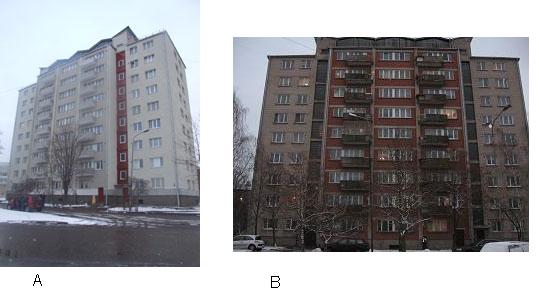
Before implementation of energy efficiency measures heat energy consumption records were not taken. Two reference buildings (32a Vienibas street and 34a Vienibas street) of the same type and with no energy efficiency measures implemented were selected to define heat energy consumption reduction. The newly insulated building and one of the reference buildings are shown in figure 5.3.
 |
|
Figure 5.3. a – Newly insulated building 38a Vienibas street, b – reference building 34a Vienibas street |
Repeated verification energy audit showed that the heat energy consumption after implementation of complex energy efficiency measures in building 38a Vienibas street in Daugavpils decreased by 51% and building specific heat consumption in real conditions is 70 kWh/m2 per year. Heat energy consumption of the reference buildings at 32a Vienibas street and 34a Vienibas street, where no energy efficiency measures were made, is 410 MWh/year (138 kWh/m2 per year) and 440 MWh/year (148 kWh/m2 per year). Consequently, the average heat energy consumption reduction after implementation of energy saving measures is 51%.
Total energy consumption (heating + hot water preparation) in the building at 38 Vienibas street is 548.8 MWh/year (185 kWh/m2 per year). In buildings at 32a Vienibas street and 34a Vienibas street, were no energy efficiency measures were implemented, the total consumption of thermal energy is 750.8 MWh/year (253 kWh/m2 per year) and 780.8 MWh/year (263 kWh/m2 per year) accordingly. Respectively, the average heat energy savings including energy consumption for hot water preparation after energy efficiency measures are taken amount to 28%.
Simple payback time of these energy efficiency measures at the heat tariff of 33 Ls/MWh is 29.6 years.
Heating company as an investor and measure implementator
In order to develop a successful and sustainable heat supply system a complex approach is needed including considering heat energy end-users. Innovative financing scheme offers a company an opportunity to invest in end-user energy efficiency improvement being involved as a financial investor, and at the same time to adjust the whole heating system. This financing scheme might be attractive for an energy supply company due to several reasons:
§ in case of heat tariff increase, customers are able to pay the bills for heating;
§ customers are satisfied with the services provided;
§ the company develops implementing innovative projects;
§ it is possible to provide the required indoor temperature for the customers;
§ it is possible to develop the entire system.
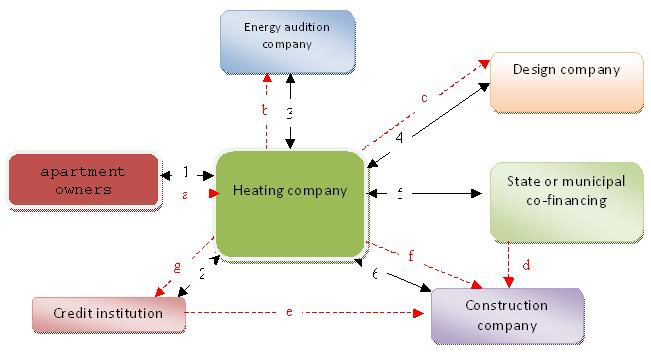
Financing scheme is shown in Figure 5.4.
 |
|
Figure 5.4. The financing scheme for energy efficiency improvement in buildings, where a heating company acts as a financing provider and project implementator (solid line arrows indicate contractual relations, dashed line arrows indicate cash flows) |
Heating company that provides heat to the building signs a contract with building owners general meeting on implementation of energy efficiency measures (1). Unlike in the situation described in the previous chapter, where building manager is just an intermediary, the heat supply company itself receives a loan and/or state or local government co-financing (2.5), or finances the project from its own funds (f).
Available financial resources cover an energy audit (3, b) development of a technical project (4, c), and energy efficiency measure implementation (6, e, d). Heat supply company receives monthly payments from the apartment owners (a), and uses them for making the payments for the loan (g). Heat supply company contracts an energy audition company for after-implementation energy consumption monitoring. This funding scheme is similar to energy services scheme described in Chapter 4.
This financing scheme is illustrated with an example of a building in Roja located at 13 Kosmonautu street, where heat supply company is planning to introduce such a financing scheme with the support of local municipality. In 2006, Roja heat supply company made a detailed analysis of energy consumption for multi-apartment buildings that are connected to the centralized heating system and identified the specific heat consumption for each building. Buildings with the highest specific consumption were selected for energy audits in year 2007, which were fully financed by Roja municipality. The information obtained during energy audits was used to carry out a detailed financial analysis using discounted cash flow method. This allowed comparing situations when energy efficiency measures were implemented in different periods of time.
Different possible options for energy efficiency measures were analysed in the financial calculations. The options were chosen on the basis of the energy audit reports. Information on the A priority activities is summarized in the table 5.2. ( activities to be implemented as soon as possible and provide the shortest payback time).
Table 5.2. A –priority measures
|
Measures |
Investments, Ls |
Savings, MWh/per year |
Savings, Ls/per year |
|
Attic floor insulation
|
4100 |
24 |
582 |
|
Basement floor insulation
|
5000 |
24 |
582 |
|
Heat piping insulation
|
1000 |
16 |
388 |
|
Total |
10100 |
64 |
1551 |
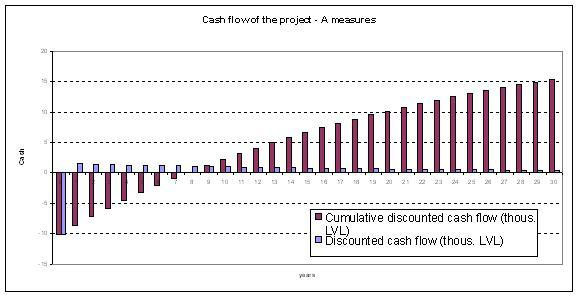 |
| Figure 5.5. Discounted cash flow for A priority energy efficiency measures |
Chart 5.5 presents discounted annual cash flow and cumulative discounted cash flow for A priority of energy efficiency measures. It shows that annual cash flow is positive throughout the project technical lifetime, but the cumulative cash flow is negative in the first 7 years, becomes positive in the eighth year it, and reaches 15,000 Ls by the end of the project technical lifetime.
A and B priorities for energy efficiency measures are summarized in Table 5.3.
Table 5.3. A and B priorities for energy efficiency measures
|
Measures |
Investments, Ls |
Savings, MWh/per year |
Savings, Ls/per year |
Payback time, years |
|
End wall insulation |
15100 |
25 |
667 |
23 |
|
Repair and sealing of window frames. Window and a wall joint seal |
1300 |
6 |
160 |
8 |
|
Replacement of doors |
2400 |
5 |
133 |
18 |
|
Installation of automatic heat regulation and bypass pipe |
3300 |
8 |
213 |
15 |
|
Attic floor insulation |
4100 |
24 |
640 |
6 |
|
Basement floor insulation
|
5000 |
24 |
640 |
8 |
|
Heat piping insulation
|
1000 |
16 |
427 |
2 |
|
Total |
32200 |
108 |
2880 |
8 |
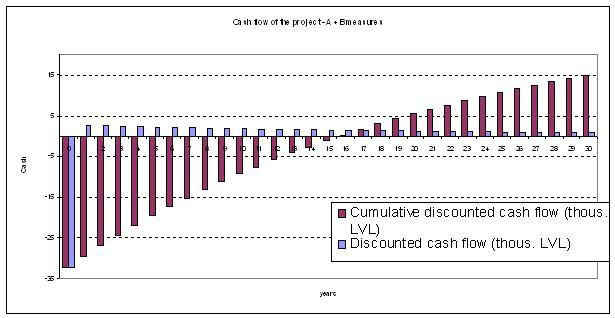 |
| Figure 5.6. Discounted cash flow for A and B priorities of energy efficiency measures |
Table 5.4. Summarized data on A, B and C priorities for energy efficiency measures
|
Measures |
Investments, Ls |
Savings, MWh/per year |
Savings, Ls/per year |
Payback time, years |
|
Front wall insulation |
26400 |
25 |
667 |
40 |
|
End wall insulation |
15100 |
25 |
667 |
23 |
|
Repair and sealing of window frames. Window and a wall joint seal |
1300 |
6 |
160 |
8 |
|
Replacement of doors |
2400 |
5 |
133 |
18 |
|
Installation of automatic heat regulation and bypass pipe |
3300 |
8 |
213 |
15 |
|
Attic floor insulation |
4100 |
24 |
640 |
6 |
|
Basement floor insulation
|
5000 |
24 |
640 |
8 |
|
Heat piping insulation
|
1000 |
16 |
427 |
2 |
|
Stairwell window replacement |
2600 |
3 |
80 |
32 |
|
Total |
61200 |
136 |
3627 |
17 |
Figure 5.7 shows discounted annual cash flow and cumulative discounted cash flow for A, B and C priorities of energy efficiency measures. It is clearly seen that annual cash flow is positive throughout the project technical lifetime, but the cumulative cash flow is negative in first 32 years, becomes positive measure in year 33, and reaches 2,000 Ls by the end of technical life of the project.
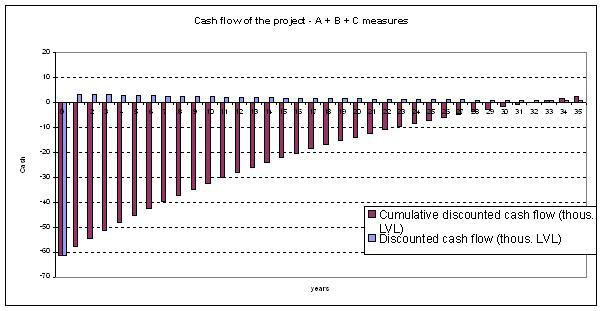 |
| Figure 5.7. Discounted cash flow for A and B priorities of energy efficiency measures |
It is possible to implement all of the proposed energy efficiency measures simultaneously when a complex renovation of the building is made. Introduction of all measures at once allows reaching maximal energy savings, but from a financial analysis point of view the most profitable is to implement only A and B priorities. C priority measures would require more investments, but in addition other benefits that are not included into investment analysis, are obtained in case of implementation. Still, they are quite significant if a full renovation of the building is chosen. These additional benefits are:
- increase of building real estate value;
- improvement of visual image of the building ;
- protection of building envelope and extension of the building’s operating life.
Roja heat supply company intends to recover the funds invested in renovation using the following principle – after implementation of energy efficiency measures, the buildings monthly energy consumption is multiplied by the tariff for heat energy and then added to the monthly loan payment amount. Then, the total amount is divided by the total heated area of the building.
SIA Ekodoma in the framework of European InoFin project has developed several financing schemes for building renovation projects. These schemes are described in details in the guidebook that describes building renovation examples where innovative financing schemes were used. It is meant for housing managers, municipalities, engineers, and regular inhabitants of buildings and presents important information on financial, technical, and legislative aspects of building renovation projects.








 «The Baltic Course» Is Sold and Stays in Business!