Analytics, Baltic, Financial Services
International Internet Magazine. Baltic States news & analytics
Tuesday, 09.06.2026, 09:31
The Independent, not IMF, compared the situation in Baltics with Iceland
 Print version
 |
|---|
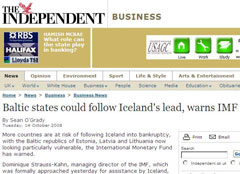
The British newspaper warned yesterday that more countries are at risk of following Iceland into bankruptcy, with the Baltic States now looking particularly vulnerable.
''Dominique Strauss-Kahn, managing director of IMF gave an interview to the Reuters news agency, where he talked about the difficult situation of Eastern-European banking. I was the one to compare Iceland with Baltics, not Strauss-Kahn,'' said O’Grady.
The IMF has also come with an announcement pointing out that they have not expressed such a comparison.
As reported, the IMF has warned that more countries are at risk of following Iceland into bankruptcy, with the Baltic States now looking particularly vulnerable, the British newspaper ''The Independent'' wrote in an article yesterday.
"The fallout for most banking systems in emerging and developing economies has been limited so far, but signs of stress are growing,'' said Dominique Strauss-Kahn, managing director of the IMF.
Strauss-Kahn said some banks in Eastern Europe have become increasingly exposed to struggling property markets, having raised funds on international money markets in the same way as the ill-fated Icelandic banks, now failed and nationalized.
These banks may be forced to reduce credit and the risk of such a scenario has risen, for instance, in the Baltic states, where house prices and credit growth have fallen, Strauss-Kahn said.
Unlike Iceland, Estonia, Latvia and Lithuania are full members of the EU, and may turn to the EU for help if their economies s begin to struggle.
Strauss-Kahn said the combination of tightening credit markets, rising domestic interest rates and the global growth slowdown could increase the force of the credit squeeze and rising defaults to a larger number of emerging markets and some developing countries. "Vulnerabilities are increasing and some countries with large current account deficits have had more difficulty financing them," he said.
Argentina, Ukraine and Kazakhstan are also increasingly mentioned as economically vulnerable nations, but the IMF has already sounded a major warning signal over eastern Europe.
In its Global Financial Stability Report, published last week, the IMF said: "House prices in eastern Europe have soared in tandem with domestic credit growth, and the credit portfolios of banks in emerging Europe have become increasingly exposed to the real estate sector."
This, said the fund, could lead to bank losses and a sharp credit crunch if the banks then contract their lending.
"The risk of such a scenario has risen, for instance, in the Baltics, where house price appreciation has slowed or prices have fallen," the report said.








 «The Baltic Course» Is Sold and Stays in Business!