Analytics, Economics, Financial Services, Interview, Lithuania
International Internet Magazine. Baltic States news & analytics
Tuesday, 09.06.2026, 13:19
Uspaskichas: Lithuania may become insolvent already in the end of 2011 or in the middle of 2012
 Print version
 |
|---|
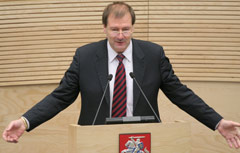
| Viktoras Uspaskichas. |
The politician is also convinced that in 15-18 years time there will be no skilled and unskilled workforce, because young people will emigrate. "It's a bomb that could explode in the future," Viktoras Uspaskichas told ELTA journalist Jadvyga Bieliavska. – Last year you were elected member of the European Parliament? What was the first year as MEP like for you?
- It was a new challenge, new experience, new job. It is life between Vilnius, Brussels and Strasbourg. In my evaluation, this year was intense, hard-working and successful, because a lot was done. I had a chance to look deeper into the EU experience, to see the problems of Lithuania from the side. I tried to draw the attention to the mistakes done by our Government that can burden the lives of Lithuanian people. From the tribune of the European Parliament, I also had a chance speak about violation of human rights in the EU, energy problems, unemployment, and prevention of natural disasters – From the tribune of the European Parliament you proposed to create strategies for youth, called to improve the employment possibilities for young people. What would be your recipe on how to fight against unemployment in Lithuania?
- Economic downturn caused huge recession in unemployment in the entire European Union. And it hit young people most – today, more than 5.5 million people (21.4%) up to 25 years in the European Union are unemployed.In Lithuania this figures are even higher – almost every third young person is unemployed. Because of unemployment young people are leaving Lithuania. It means that in 15-18 years time, we will have no skilled or unskilled workforce. I would say this is a bomb that might explode in the future. The Government has no strategy and is not thinking about the fact that in 10-20 years we will lose a whole generation of people. It means that there will be nobody to feed pensioners and maintain the state.
- What is your evaluation of the European Commission's proposal to extend the retirement and the intention of the Lithuanian Government to introduce a 65-year pension age? – The Labour Party will not approve of that, because we see that the Government is not even by 20% using economic leverage to revive the economy, to help the state earn money and ensure social security for pensioners.
The Government of Andrius Kubilius is unable to do that because it has no income, and they have no income because the Government is not aware of the economy and market laws. – Already in autumn 2007 you warned about the impending global economic crisis. In the end of 2009 and in the beginning of 2009, you also predicted that Lithuania might find itself on the brink of bankruptcy. When do you think Lithuania will get out of the crisis?
- Taking into account how our government is working today, I think that Lithuania will become insolvent in the end of 2011 or the beginning of 2012. The country might find itself on the brink of bankruptcy.
There is a need to make decisions that would foster the economy and generate business. To my mind, having hit the bottom, we could get out of the crisis in 10 years time. – A year ago, Lithuania elected a new president. What is your evaluation of the first year in office of President Dalia Grybauskaite?
- Her rhetoric is good, transparent, and, what is more important, understandable to people. But you cannot feed people with rhetoric, rhetoric will not solve problems. After rhetoric, there should be results, but we miss that. To my mind, that's the biggest problem of Grybauskaite's presidency. Of course, this can be partially written off, because it is her first year in office. I hope that next year the head of the state will have more achievements in terms of results.
But our president is a good specialist in the areas of economy and finance. (&). She has to force the Government to work, because, otherwise, the state will become insolvent. Then it will be late to dissolve the Seimas and the Government.









 «The Baltic Course» Is Sold and Stays in Business!