Analytics, Book review, Economics, History, Lithuania, Statistics
International Internet Magazine. Baltic States news & analytics
Tuesday, 09.06.2026, 13:19
Lithuanian Statistics celebrates 90th birthday
 Print version
 |
|---|
90 years ago, on 6 September 1919, by the order of Jonas Šimkus (the Minister of Commerce and Industry) the Department of General Statistics was established. This date is considered to be the date of birth of Lithuanian statistics. The first director was V. Petrulis – financier, one of the "fathers of the Lithuanian litas", who died in Gulag in 1942. At that time the Department had general, finance, commerce and trade and demographic divisions and an office.
In 1921, the statutes of the Standing Statistical Commission were announced. The Central Statistical Bureau under the Ministry of Finance, which started functioning in 1921 as well, became an executive body. Each public institution intending to collect statistics had to submit a work plan to the Central Statistical bureau, which then provided the inspected work plan for the approval of the Standing Statistical Commission.
The main task of the Central Statistical Bureau was to determine the population of Lithuania and to lay the basis for foreign trade, industry and price statistics. In 1924, the production of foreign trade statistics was launched; in 1927, the first Lithuania national payments balance was prepared. However, the most important tasks of the Independent Lithuania’s statistics were population and agricultural censuses. In 1922, the Steigiamasis Seimas (the Constituent Assembly of Lithuania) passed the Law on the Overall Population Census. The overall Population Census was conducted in 1923, the overall Agricultural Census – in 1930.
The most important persons who helped to lay the foundations of national statistics: Professors – A. Rimka and G. Galvanauskas-Galva, the directors – G. Feterauskas, D. Micuta, and other interwar statistics theoreticians and practicians – J. Dagys, A. Dargis, D. Cesevičius, F. Jurskis, S. Laptevas, V. Palčiauskas, A. Puodžiukynas, P. Slavėnas, P. Tamošaitis, A. Tarulis.
In 1940, a Soviet statistics development stage started. The Central Statistical Bureau in Kaunas was reorganized to a Central Statistical Bureau in the system of the Financial People’s Commissariat in Vilnius. Later, it was replaced by the National Economic Accounting Board, which in 1944 was renamed the Statistical Board and affiliated to the State Planning Committee of the Lithuanian SSR. From 1948, the Statistical Board was repeatedly reorganized – its name and subordination were changed. Finally, in 1987, the Central Statistical Board was reorganized to the National Statistical Committee of the Lithuanian SSR.
After the restoration of independence, a new phase in Lithuanian statistics started. On 18 April 1990, under the Resolution of the Government of the Republic of Lithuania, the Department of Statistics to the Government of the Republic of Lithuania (Statistics Lithuania) was established.
Rearrangement of national statistics was started, taking into consideration market economy needs – new international methodologies and standards were introduced, successful accession to the European Statistical System was implemented. “Today we can produce harmonized official statistics that is comparable on an international scale” – V. Lapėnienė, Acting Director General, said.
In recent years, the main priorities of Statistics Lithuania have been as follows: the development of statistical areas, expansion of the range of services offered and quality improvement, cultivation of statistical literacy of society. A necessity emerged to statistically estimate certain phenomena, e.g. undeclared migration, black economy, tourist flows, activity of foreign enterprises in Lithuania and Lithuanian enterprises abroad, service producer prices and structure of such services, etc. However, one of the main priorities remains the reduction of the statistical response burden. The aim is that the quality official statistics would be produced without burdening the respondents.
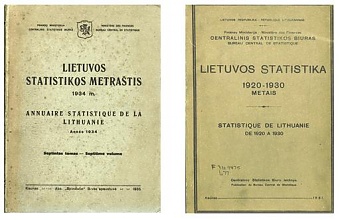
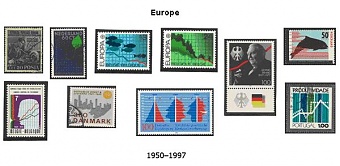
Everyone who is interested in the history and the present of national statistics is invited to the library-bookshop of Statistics Lithuania, to the exposition of the historical statistical publications and statistics-related stamps. Information is provided on the website of Statistics Lithuania.
 |
|---|
Statistics-related stamps were issued by more than 130 countries. Some of these stamps are dedicated to censuses, anniversaries of statistics institutions; other stamps show stylized statistical information about various statistical areas, diagrams or maps. Statistics-related stamps also cover stamps dedicated to scientists – theoreticians and practicians in the field of statistics, as well as politicians who granted much of their attention to statistics, etc. Although small but very interesting and valuable part of philately related to statistics is presented in the exposition.
The oldest publication in the library is Statistika naselennich mest, Suvalkskaja gubernija issued in Warsaw in 1891, as well as copies of some historical publications, prepared and released by the Central Statistical Committee to the Ministry of Internal Affairs of the Russian Empire and Warsaw Statistical Committee of the Kingdom of Poland, statistical yearbooks of Lithuania since 1918.








 «The Baltic Course» Is Sold and Stays in Business!